
When you discover a leak on your property, choosing the right waterproofing solution can feel overwhelming. In Cape Town, two of the most effective and popular methods are torch on and liquid waterproofing. But how do you know which one is the right fit for your roof, balcony, or basement? This guide will help you understand the key differences, benefits, and ideal applications of each, so you can choose the most durable and cost-effective solution for your property.
What is Torch On Waterproofing?
Torch on waterproofing involves applying a sheet membrane made from modified bitumen, a type of asphalt. As the name suggests, a professional technician uses a propane torch to heat the underside of the membrane, melting it so it fuses securely to the underlying surface. This process creates a thick, tough, and completely seamless waterproof layer that is exceptionally durable. It is a go-to solution for large, flat areas that need robust protection.
Key Advantages of Torch On Membrane
- Exceptional Durability: Torch on membranes are renowned for their long lifespan, typically lasting 15 to 20 years or more with proper installation and maintenance.
- High Resistance: The thick membrane is highly resistant to UV rays from the harsh Cape Town sun, as well as punctures and regular foot traffic.
- Uniform Thickness: Because it is a factory-made sheet, the thickness is consistent across the entire surface, ensuring there are no weak spots.
- Proven Performance: It is an excellent choice for the flat concrete roofs and commercial properties commonly found throughout Cape Town.
Potential Disadvantages to Consider
- Requires Specialist Skill: The use of an open flame makes this a high-risk application that must only be performed by highly trained and experienced professionals.
- Limited Flexibility: It is not the best option for roofs with complex shapes, multiple vents, pipes, or other detailed features.
- Temperature Sensitivity: Over many years, the material can become less flexible in extreme temperature fluctuations.
What is Liquid Waterproofing?
Liquid waterproofing, often referred to as a liquid-applied membrane (LAM), is a specialised coating that is applied in liquid form and cures to form a seamless, flexible, and rubber-like waterproof barrier. Common types include acrylic, polyurethane, and advanced liquid rubber compounds. It is typically applied with a roller, brush, or spray, much like paint, allowing it to conform perfectly to any shape or surface detail.
Key Advantages of Liquid-Applied Membranes
- Excellent for Complex Shapes: Its liquid nature means it can easily waterproof around difficult areas like pipes, vents, drains, and skylights.
- Seamless and Fully Bonded: It creates a single, continuous membrane with no joints or seams, which are often the weakest points in other systems.
- Remains Flexible: The cured membrane can stretch and move with the building, effectively bridging small cracks that may develop over time.
- Safer Application: The installation process is much safer as it does not require an open flame.
Potential Disadvantages to Consider
- Dependent on Applicator Skill: Achieving a consistent, correct thickness is critical for performance and relies heavily on the skill of the technician.
- Puncture Resistance: While durable, some liquid systems may be less resistant to punctures than a thick torch on sheet membrane.
- Weather Dependent Curing: The time it takes for the liquid to cure can be affected by temperature, humidity, and rain.
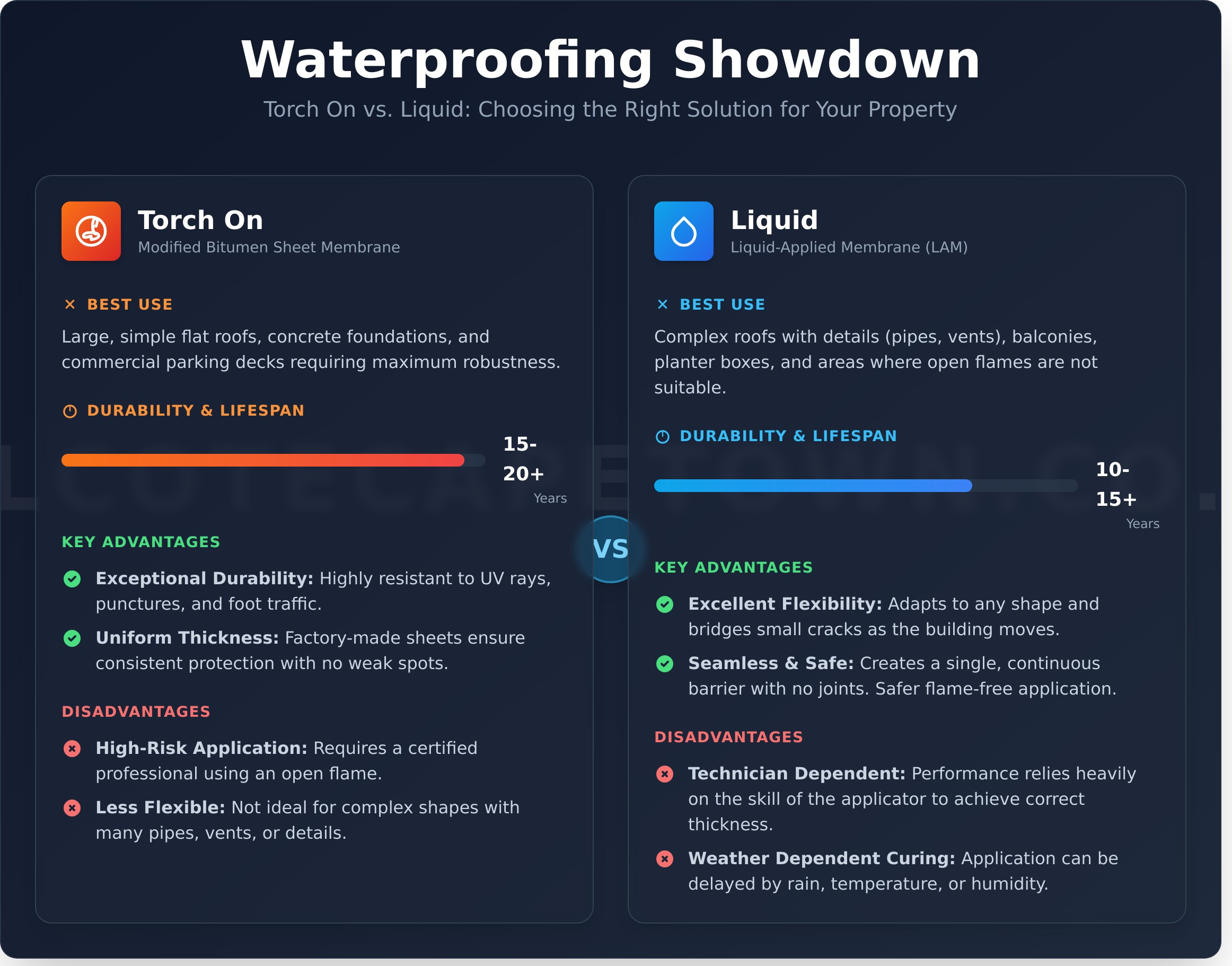
Head-to-Head: Torch On vs Liquid Waterproofing Comparison Table
To make the choice clearer, here is a simple table comparing the key features of both waterproofing methods.
| Feature | Torch On Waterproofing | Liquid Waterproofing |
|---|---|---|
| Best Use | Large, simple flat roofs, foundations, parking decks. | Complex roofs, balconies, planter boxes, areas with many details. |
| Durability | Excellent (15-20+ years). High puncture and UV resistance. | Very good (10-15+ years). Varies by product and thickness. |
| Flexibility | Good, but can become less flexible over time. | Excellent. Stretches to accommodate building movement and bridge cracks. |
| Application | Requires open flame and certified professionals. | Safer roller/brush/spray application. Skill needed for even thickness. |
| Cost | Often more cost-effective for large, open areas. | Can be more cost-effective for smaller, complex areas due to less labour. |
Best for Your Property Type in Cape Town
- Torch On is the undisputed champion for large commercial flat roofs, parking decks, and concrete foundations where maximum durability is the priority.
- Liquid Waterproofing is the ideal choice for residential balconies, complex roof shapes with multiple penetrations, and planter boxes where flexibility is key.
- Considering Cape Town’s intense sun and driving winter rains, both methods are effective, but the choice depends on the specific surface and structural needs.
Making the Final Decision: Which Should You Choose?
- Choose Torch On if you need maximum, long-term durability for a large, simple, and accessible surface.
- Choose Liquid Waterproofing if your project involves intricate details, complex shapes, or if flame application is not feasible.
- Ultimately, the best solution is one that is specified by a professional after a thorough inspection of your property. An expert can identify underlying issues and recommend the system that will provide the best long-term value and protection. If you are unsure, it is always best to get a free, expert assessment for your property.
FAQs about Waterproofing Methods
How long does torch on waterproofing last?
With professional installation and periodic maintenance (like ensuring drains are clear), a torch on system can easily last 15 to 20 years, and sometimes even longer.
Can you apply torch on waterproofing over existing materials?
It depends on the condition of the existing surface. In many cases, the old, failed waterproofing must be completely stripped to ensure the new membrane can bond directly and securely to the substrate.
Is torch on waterproofing expensive in Cape Town?
The cost can vary based on the size of the area, its condition, and accessibility. For large, open surfaces, it can be one of the most cost-effective solutions due to the speed of application.
Can you tile over torch on waterproofing on a balcony?
Yes, you can. A protective screed is typically laid over the torch on membrane before tiling to protect it from damage during the tiling process and to provide a suitable surface for the tile adhesive.
Which method is better for a flat concrete roof?
For a large, simple flat concrete roof, torch on waterproofing is often the preferred method due to its exceptional durability and resistance to ponding water.
Do you provide a guarantee for your waterproofing?
Absolutely. At Wilcote Cape Town, we are confident in our workmanship and the quality of our locally manufactured products. That is why we back our waterproofing projects with a 10-year leak-free warranty for your peace of mind.
Choosing the right waterproofing system is a critical investment in protecting your property. By understanding the unique strengths of both torch on and liquid-applied membranes, you can make an informed decision. At Wilcote Cape Town, our expert technicians are trained in all methods and can provide a comprehensive assessment to recommend the perfect solution for your specific needs, backed by our 10-year leak-free warranty. Request Your Free Waterproofing Quote Today!