
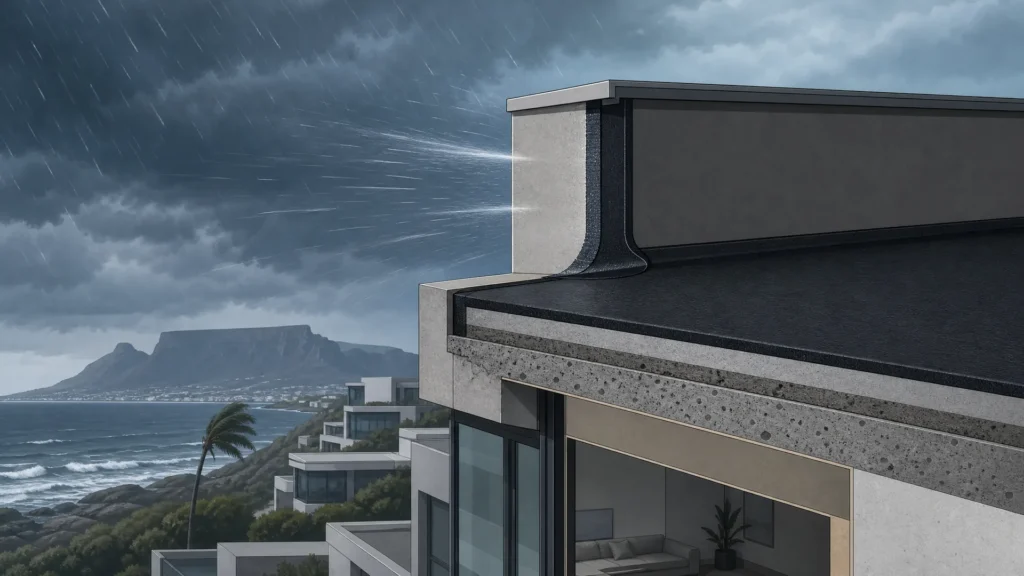
Waterproofing Cape Town properties is not optional, it is one of the most cost-effective decisions a property owner can make before the winter rains arrive. Cape Town’s wet season is already underway in 2026, and buildings without sound membrane protection are accumulating damage right now. The right waterproofing system, correctly installed, stops that damage in its tracks.
Why Cape Town’s Climate Demands Serious Waterproofing
Cape Town sits in a Mediterranean climate zone, hot, dry summers followed by cool, wet winters. That cycle is precisely what makes waterproofing so critical here.
The wet season threat: what Cape Town winters actually do to buildings
Cape Town receives the bulk of its annual rainfall between June and August. In peak years, consecutive south-westerly fronts drive water horizontally into parapets, window sills, and expansion joints for weeks at a time. Those conditions expose every weakness in an ageing membrane within a single season.
The wet-dry cycle is the real aggressor. Summer heat expands building materials; winter moisture contracts them. That repeated movement cracks older membranes, opens grout lines, and separates flashings from substrates. Each failure point becomes an entry route for water.
Common failure points: roofs, parapet walls, and below-slab areas
The most frequently damaged areas in Cape Town buildings are:
- Flat and low-pitch roofs, water pools rather than drains, accelerating membrane fatigue
- Parapet walls, the junction between the wall cap and the roof membrane is a chronic weak point
- Expansion joints, flexible seals harden and crack over time
- Below-slab areas, basements and ground-floor slabs face rising damp from saturated winter soil
Flat-roof commercial buildings in Cape Town’s southern suburbs, including those in Claremont, Wynberg, and the Cape Flats industrial belt, are among the most frequently affected by pooling water and membrane failure during the June–August peak rain season.
Torch-On Waterproofing Cape Town: The Gold Standard for Roof Protection
Most property owners have heard of roof waterproofing. Fewer have heard a clear explanation of why torch on waterproofing Cape Town contractors recommend outperforms the alternatives. Here is the case.
How the torch-on method works
Torch-on waterproofing uses a bitumen-modified polyester membrane. The installer heats the underside of the membrane roll with a propane torch, fusing it directly to the prepared substrate as it unrolls. The heat creates a continuous, monolithic bond, no adhesive, no mechanical fixings, no cold joints.
The result is a membrane that conforms tightly to the substrate, moves with the building, and leaves no unsealed lap edges for water to exploit.
Why torch-on outperforms paint-on and liquid membranes in wet climates
Brush-applied and roll-on liquid membranes depend on adhesion to a surface that will inevitably flex. When the substrate moves, the coating lifts or blisters, sometimes within the first winter season. Every blister traps moisture and accelerates the failure it was meant to prevent.
Torch-on bitumen membranes are heat-fused directly to the substrate, eliminating the cold joints and lap edges that are the primary failure point of adhesive or brush-applied membranes. In Cape Town, where sustained rainfall tests every seam across three full months, that difference in bond quality is the difference between a dry ceiling and an emergency repair call.
Torch-on is especially well-suited to the flat and low-pitch roofs common on Cape Town commercial and industrial buildings, where standing water is a routine load rather than an occasional event.
Roof Waterproofing vs. Damp Proofing: Choosing the Right Solution
These two terms are often used interchangeably, but they describe different problems with different solutions.
Roof waterproofing addresses above-grade, weather-driven water. Rain hits a roof or wall, finds a breach, and enters the building from above. Membrane systems, torch-on bitumen, polyurethane coatings, acrylic sealants, are designed for this load.
Damp proofing addresses moisture that moves upward or inward from the ground. Rising damp occurs when capillary action draws ground water up through masonry or concrete. Below-slab moisture enters through an inadequate or failed slab membrane. Damp proofing specialists use different materials and techniques to interrupt that movement, typically crystalline coatings, cavity drainage, or below-slab membranes installed during construction or retrofit.
A building can need both. A Cape Town warehouse may have a sound roof but a damp ground floor. A residential property may have dry walls but a leaking parapet. Identifying which problem you have, or whether you have both, determines the right scope of work.
Leak Prevention: Fixing It Before It Becomes a Crisis
The commercial case for leak prevention over emergency repair is straightforward: reactive work always costs more. A burst ceiling, mould remediation, or structural concrete repair mid-winter carries emergency labour rates, potential tenant disruption, and collateral damage to finishes and stock.
Early warning signs every property owner should know
Inspect these indicators before and during the wet season:
- Stained or discoloured ceilings, brown water marks indicate an active or historic leak above
- Bubbling or peeling paint, moisture trapped behind a painted surface is forcing its way out
- Efflorescence on masonry, the white crystalline deposit on brick or plaster means water is moving through the wall and depositing dissolved salts on the surface
- Visible membrane lift or blistering, check flat roof surfaces after the first rain event
- Damp or musty odour in enclosed spaces, often the first sign of below-slab moisture
Any one of these signs warrants an inspection. Multiple signs warrant urgent attention.
Preventative maintenance schedule for Cape Town properties
A property owner who books a pre-winter inspection in April or May can address hairline cracks and membrane lift before the first cold front arrives, avoiding the far costlier scenario of ceiling collapse, mould remediation, or structural concrete repair mid-winter.
A practical maintenance schedule for Cape Town looks like this:
| Period | Action |
|---|---|
| April–May | Full roof and parapet inspection; repair any membrane lift, cracked sealant, or blocked drains |
| June–August | Monitor for new staining or leaks during active rain events |
| September–October | Post-winter inspection; document any new failures before they worsen over summer |
Commercial and industrial property managers should log each inspection. That record supports insurance claims if water ingress causes significant damage.
Material Durability and Long-Term Weather Protection
Material choice directly determines how long weather protection lasts and when you will next need to spend money on the same roof.
Torch-on bitumen membranes, correctly installed, these deliver a service life measured in decades rather than years. The heat-fused bond resists UV degradation and thermal cycling better than adhesive-applied alternatives.
Polyurethane coatings, suitable for complex roof geometries and vertical surfaces. They remain flexible at low temperatures, which matters during Cape Town winters. Service life is shorter than torch-on but longer than standard acrylic.
Acrylic sealants and coatings, useful for maintenance, detailing around penetrations, and low-movement joints. Not a standalone solution for primary roof waterproofing on commercial buildings.
For commercial clients, the clearest frame is investment versus maintenance spend. A torch-on membrane installed today trades a higher upfront cost for a significantly extended replacement cycle. Deferred waterproofing compounds costs: the membrane fails, water enters, finishes are damaged, structure may be affected, and the membrane still needs replacing, now alongside everything else.
Why Cape Town Property Owners Choose Wilcote for Waterproofing
Wilcote Cape Town’s waterproofing team works across residential, commercial, and industrial properties, carrying out torch-on membrane installations, parapet sealing, and below-slab damp proofing as part of integrated building projects. Because waterproofing failures often reveal themselves during broader renovation work, Wilcote operates as licensed home renovation contractors in Cape Town, able to address the full scope of damage rather than the membrane alone.
The 2026 wet season is already active. If your property has not had a waterproofing inspection this year, the window for low-cost preventative work is narrowing.
Contact Wilcote Cape Town today to book an inspection or to request a torch-on membrane quote. Addressing the problem now costs a fraction of what emergency repairs mid-season will.