
Choosing the wrong waterproofing system costs more than the price difference at installation, it costs you in repairs, callbacks, and premature replacement. When comparing torch on waterproofing vs other methods, the differences go well beyond application technique. Lifespan, climate performance, substrate compatibility, and total cost of ownership all shift significantly depending on which system you choose. This guide breaks down each major method, maps them to real-world scenarios, and explains which one genuinely suits Cape Town’s demanding weather cycle.
What Is Torch On Waterproofing and How Does It Work?
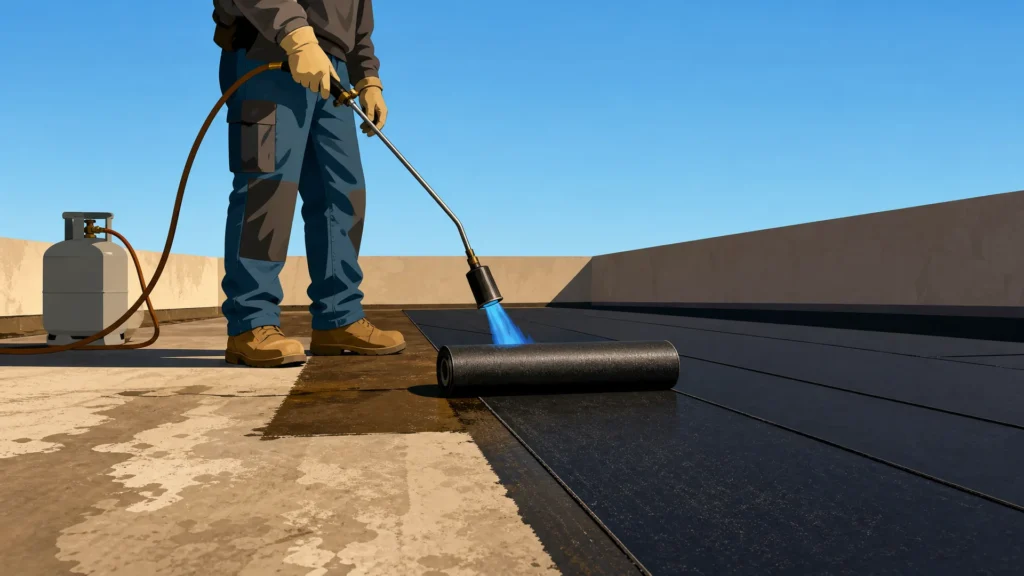
Torch on waterproofing uses a bitumen-modified membrane, typically APP (atactic polypropylene) or SBS (styrene-butadiene-styrene) modified, that is bonded to a substrate using an open-flame propane torch. The heat melts the underside of the membrane and the surface of the primer coat simultaneously, fusing them into a single continuous layer.
This heat-fused bond is the core advantage. Unlike adhesive or peel-and-stick systems, there is no separate glue layer that can degrade over time. The membrane and substrate become, in practical terms, one unified barrier.
The Installation Process Step by Step
-
Substrate preparation, the surface is cleared of debris, loose material, and contamination. Existing cracks are repaired and the deck is checked for moisture content. Experienced roofing contractors consistently note that the quality of substrate preparation, cleaning, priming, and crack repair before torching, determines at least half of a membrane’s real-world longevity, regardless of product grade.
-
Priming, a bitumen primer is applied and allowed to cure. This improves adhesion and seals micro-pores in the concrete or screed.
-
First layer torching, the base sheet is unrolled incrementally, with the torch applied to the membrane’s underside. The installer rolls forward as the bitumen flows and bonds.
-
Seam overlapping, sheets overlap by at least 100–150 mm at side laps and end laps. Each seam is fully torched and pressed to eliminate voids. This is what creates the near-seamless barrier that resists lateral water ingress.
-
Cap sheet application, a second, UV-resistant cap sheet is torched over the base layer on exposed roofs, adding both protection and longevity.
The result is a multi-layer system where water has no mechanical gaps to exploit, a significant advantage over brush-applied or self-adhesive alternatives.
Waterproofing Comparison: The Main Methods at a Glance
No single waterproofing method suits every application. Understanding the field is the starting point for any credible waterproofing comparison.
Liquid Waterproofing vs Membrane Systems
Torch on membrane, heat-fused APP or SBS bitumen sheet, 3–5 mm thick. Best suited for flat and low-slope roofs, balconies, and parapets. Offers the strongest seam integrity and longest service life in exposed conditions.
Liquid waterproofing, brush, roller, or spray-applied elastomeric coatings (polyurethane, acrylic, or bitumen emulsion). Excellent for complex geometries, internal wet areas, and surfaces that are difficult to overlay with sheet material. Performance depends heavily on application thickness and reapplication frequency. Liquid systems cost less upfront but require more maintenance cycles, that is the core trade-off in the liquid waterproofing vs membrane debate.
Self-adhesive peel-and-stick membranes, cold-applied sheet systems that use a factory-applied adhesive backing. Suited to below-slab applications and situations where open flame is a site restriction. Seam reliability is generally lower than torch on under long-term thermal movement.
Comparison summary:
| Method | Best Use Case | Flame Required | Relative Longevity |
|---|---|---|---|
| Torch on membrane | Flat/low-slope roofs, parapets | Yes | High |
| Liquid coating | Wet rooms, complex shapes, rooftops as top coat | No | Moderate |
| Peel-and-stick sheet | Below-slab, flame-restricted sites | No | Moderate |
| Cementitious | Below-ground, tanks, wet rooms | No | High (in-ground) |
Cementitious and Acrylic Coatings
Cementitious waterproofing is the preferred choice for below-ground basement walls and concrete water tanks because it bonds chemically to the substrate, a use case where a torch on membrane or liquid elastomeric coating would be impractical or unsafe. It tolerates negative-side water pressure, making it the right call for below-slab tanking and potable water containment.
Acrylic coatings sit at the budget end of the spectrum. They are fast to apply and suitable for low-traffic roof areas but degrade under sustained UV exposure faster than polyurethane liquids, and far faster than torch on membranes.
Durability Analysis: Which Method Lasts Longest?
The headline is straightforward: APP-modified bitumen torch on membranes are widely cited in roofing literature as having a service life of 15 to 25 years on flat and low-slope roofs when correctly installed and maintained. Brush-applied liquid coatings often need reapplication every 3 to 7 years.
That gap is the central argument for torch-on protection during Cape Town’s wet seasons, a longer interval between interventions means fewer disruptions, fewer contractor call-outs, and lower cumulative spend.
Two factors drive deterioration across all systems:
- UV exposure, breaks down polymers in liquid coatings faster than the stabilised APP compound in quality torch on membranes. A cap sheet with mineral granule surfacing adds a further UV buffer.
- Ponding water, accelerates seam failure in any system with mechanical joints. The fused seams of torch on membranes are far less susceptible than taped or glued laps in peel-and-stick products.
Maintenance matters too. Even a 20-year torch on membrane will underperform if seams at penetrations (pipe collars, drain sumps) are not inspected and touched up after severe storm seasons. Seasonal roof maintenance to prevent leaks is a practical complement to any waterproofing system, not a substitute for choosing the right one.
Climate Suitability: Torch On Roofing Methods in Cape Town’s Weather
Cape Town’s Mediterranean climate creates a dual threat for waterproofing: intense, sustained winter rainfall from May to August, followed by harsh UV radiation and surface temperatures that regularly exceed 35 °C in summer. Few waterproofing systems handle both ends of that spectrum equally well. This is where torch on roofing methods establish a clear advantage.
Wet Winter Season Considerations
Cape Town’s winter frontal systems deliver driving rain at oblique angles, sustained over multiple days. Flat and low-slope roofs pool water. Any seam weakness, a poorly adhered lap, a pinhole in a liquid coat, a lifted edge, becomes a leak point within hours.
The heat-fused, overlapping seams of a properly installed torch on membrane leave no mechanical joints for water to penetrate laterally. A single-coat liquid system applied over an aging screed, by contrast, is vulnerable at thin spots, surface cracks, and penetration details. A typical Cape Town commercial flat roof, subject to pooling during winter storms and 35 °C+ summer surface temperatures, illustrates exactly why a heat-fused, APP-modified torch on membrane outperforms a single-coat liquid system applied directly over an aging screed.
Summer UV and Heat Cycling
Cape Town summers bring intense UV radiation and daily thermal cycling, roofs heat up through the day and cool overnight. This expansion and contraction stresses any waterproofing system at joints, flashings, and penetrations.
APP-modified membranes are formulated for high-temperature stability. They resist softening and flow at elevated surface temperatures better than SBS-modified equivalents. Thin acrylic or bitumen-emulsion coatings can chalk, crack, and lose elasticity within a few seasons of Cape Town summer exposure.
Quality torch on membranes with mineral granule cap sheets reflect a portion of solar radiation, reducing surface temperature and slowing thermal degradation. This directly extends service life in sun-intense climates.
Cost Effectiveness: Upfront Price vs Long-Term Value
The cost effectiveness argument for torch on waterproofing is not about the day-one invoice. It is about total cost of ownership across the building’s life.
Torch on installation costs more than brush-applied liquid coatings. The materials are more expensive, the application requires specialist labour and equipment, and the process takes longer. These are real costs and should be acknowledged directly.
Liquid coatings typically need reapplication every 3 to 7 years, and each cycle carries its own labour, material, and disruption cost. A torch on membrane installed correctly in 2026 may require only inspection and penetration maintenance until the late 2030s or beyond, a fundamentally different cost trajectory.
For commercial and industrial property owners, the maintenance overhead difference is especially significant. A warehouse, logistics facility, or retail centre cannot easily accommodate repeated contractor access to the roof. Every additional maintenance cycle carries operational disruption on top of direct cost.
Wilcote Cape Town’s project experience across Cape Town’s commercial and residential roofing portfolio shows that buildings treated with torch on membranes have far fewer callback repairs than those with liquid-only treatments applied in the same period, a pattern consistent with the longevity data the industry widely accepts.
Choosing the Right Waterproofing Method for Your Property
The correct method depends on the application, not on a single performance ranking. Use this decision framework:
Flat or low-slope commercial roof → Torch on membrane. The durability, seam integrity, and long maintenance interval make it the dominant choice. Consider double-layer systems for roofs with a history of ponding.
Residential flat roof or balcony → Torch on is still the premium choice, particularly for home extension projects that require new waterproofing where long-term performance matters more than the lowest day-one cost.
Internal wet rooms (bathrooms, showers) → Liquid polyurethane or cementitious coating. Torch on membrane is impractical in confined internal spaces with combustion risk.
Below-slab or basement tanking → Cementitious coating or self-adhesive peel-and-stick sheet. These substrates require negative-side pressure resistance or flame-restricted application, both disqualify torch on.
Pitched roof waterproofing layer → Self-adhesive underlays or liquid coatings under tiles. Torch on is used on pitches only in specific detail areas (valleys, hips, penetrations).
The most important step in any of these scenarios is a proper site assessment by a qualified contractor. Substrate condition, drainage design, existing waterproofing layers, and access constraints all influence specification. Working with licensed home renovation contractors in Cape Town who carry direct experience with local weather conditions reduces specification risk significantly.
If you are managing a commercial property, planning a renovation, or dealing with a persistent leak that liquid coatings have failed to fix, contact Wilcote Cape Town for a professional waterproofing assessment. The right specification, applied correctly the first time, is always the most cost-effective outcome.