
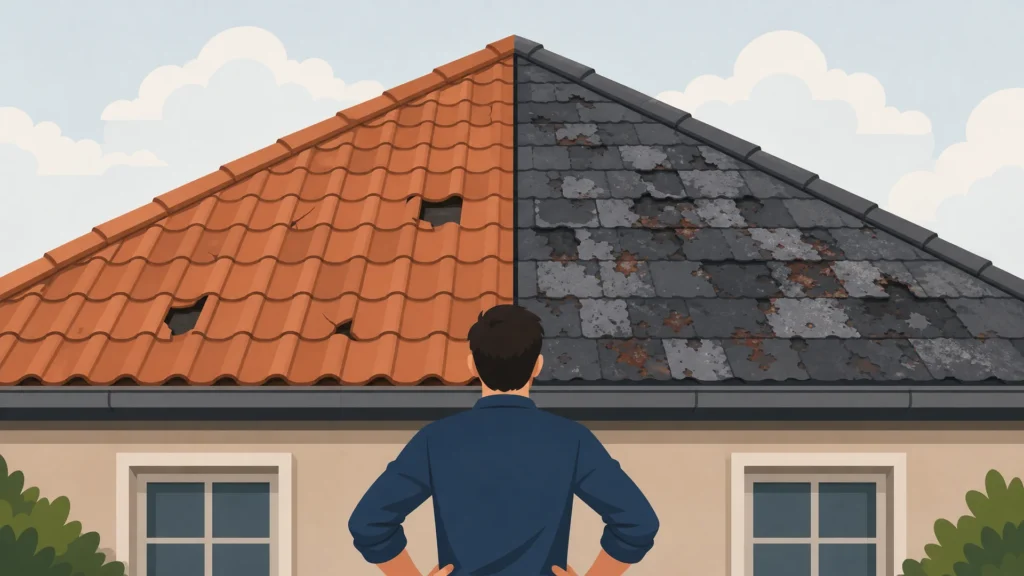
Deciding when to repair vs replace roof is one of the most financially significant choices a homeowner faces. Get it wrong in one direction and you spend years patching a failing structure. Get it wrong in the other and you pay for a full replacement when a targeted repair would have bought another decade of service life. This guide gives you a clear framework, a decision tree, a cost comparison, and a practical inspection checklist, so you can walk into any contractor conversation fully informed.
How to Read the Signs: Repair or Replace?
The core tension is simple: isolated, surface-level damage usually points to repair, while widespread or structural damage points to replacement. The challenge is reading which category you’re actually in.
Damage indicators that call for a repair
These situations are typically good repair candidates:
- A few missing or cracked tiles in one area, with the rest of the roof sound
- A single leak point traced to a failed flashing, a cracked ridge cap, or a displaced tile
- Minor corrosion spots on a metal roof that is otherwise structurally intact
- Small punctures or isolated blistering on a flat membrane roof
A flat torch-on membrane roof with isolated blistering or a small puncture is a strong repair candidate. When more than a third of the membrane surface shows cracking, delamination, or pooling water, a full re-membrane is the more cost-effective path. Knowing where your roof sits on that scale is the first step in any damage assessment.
Roof replacement signs you should never ignore
These are the roof replacement signs that indicate the structure has moved beyond patchwork solutions:
- Visible sagging or dipping across any section of the deck
- Multiple active leak points inside the property after a single rain event
- Daylight visible through the roof boards from inside the attic
- Widespread tile cracking, spalling, or delamination across most of the surface
- Structural timber rot underneath the covering
When you see two or more of these together, repairs are likely to be short-term at best. The underlying substrate is failing, not just the surface layer.
Roof Lifespan: Know Where Your Roof Stands
A roof’s age is one of the clearest factors in the repair-vs-replace decision. A 10-year-old roof with a leak is a repair problem. The same leak on a 35-year-old roof is often the beginning of a replacement conversation.
Typical lifespan by roofing material
Roof lifespan varies significantly by material. Here are the common types used across Cape Town:
| Material | Approximate Service Life |
|---|---|
| IBR / corrugated metal sheeting | 25–40 years |
| Concrete tiles | 30–50 years |
| Fibre cement tiles | 20–35 years |
| Flat torch-on membrane | 15–25 years |
| Kliplok and concealed-fix metal | 30–50 years |
Metal roofing systems (IBR and corrugated sheeting) commonly used across Cape Town’s residential and industrial buildings typically carry a service life of 25–40 years when correctly installed and maintained. Coastal salt air and the Cape’s seasonal winds can push wear toward the lower end of that range.
Fibre cement tiles sit at the shorter end of the spectrum. By the time they reach 25 years, surface erosion and moss penetration often make repeated repairs uneconomical.
How Cape Town’s climate accelerates wear
Cape Town’s climate creates a specific wear pattern that homeowners need to understand. Wet, cold winters drive moisture into any existing crack or joint. The fierce south-easter then bakes that moisture out through summer, causing constant expansion and contraction cycles.
UV intensity at this latitude is high, which degrades bitumen membranes, tile surface coatings, and sealants faster than in milder climates. Coastal properties add salt-laden air into the equation, accelerating corrosion on all metal components, including fixings, flashings, and gutters.
Moss and lichen growth on concrete or fibre cement tiles is more than cosmetic: root-like structures from lichen physically break down tile surfaces over time, accelerating moisture infiltration and shortening the effective lifespan of an otherwise sound roof. Seasonal roof maintenance in Cape Town directly extends the window before replacement becomes necessary, which is why it should not be treated as optional.
Cost Comparison: Repair vs Replacement
Cost is usually the deciding factor, and it is worth framing this carefully rather than focusing only on today’s quote.
What drives repair costs
Repair costs are shaped by:
- Extent and accessibility of the damage, a single ridge repair costs far less than replacing flashings across a complex multi-slope roof
- Material availability, matching tiles on an older roof can be difficult if the profile is discontinued
- Number of previous repairs, each patch can mask further deterioration underneath, making the next repair more expensive
- Labour access, steep pitches and high buildings increase scaffolding and safety requirements
Repair is the right financial choice when the damage is genuinely isolated and the rest of the roof has significant service life remaining. The danger is repeated repair spend on a roof that is systematically failing. Costs that compound over two or three years can easily exceed the price of a single replacement.
What drives full replacement costs
Replacement costs are influenced by:
- Roof area and complexity, a simple single-pitch IBR roof costs considerably less per square metre than a multi-valley tiled roof
- Material chosen, concrete tiles, metal sheeting, and membrane systems each sit at different price points
- Substrate condition, if roof timbers or decking need replacement, this adds to the total
- Access and waste removal, stripping an old roof and disposing of materials is a significant cost component
The 50% rule is widely cited in roofing practice: if the cost of a repair exceeds 50% of what a full replacement would cost, especially on a roof already past its mid-life, replacement almost always delivers better long-term value. Replacement resets the cost clock; repeated repairs do not.
For flat roofs, understanding your options before committing matters. Read about torch-on waterproofing vs other methods to understand where different systems sit on cost and longevity.
Roof Repair Decision Guide: A Simple Framework
Use this checklist as your roof repair decision guide before contacting a contractor. Answer each question honestly, the pattern of answers will point clearly toward repair or replacement.
How old is the roof?
- Under half its expected service life → favour repair
- Past two-thirds of expected service life → lean toward replacement
How widespread is the damage?
- One or two isolated areas → repair likely sufficient
- Damage visible across multiple areas or roof sections → replacement investigation warranted
How many times has this roof been repaired in the last five years?
- One or no repairs → repair is reasonable
- Two or more repair events → systemic failure is likely; get a replacement quote
Does your insurance cover the damage?
- Storm or accidental damage may be claimable, check your policy before committing to any spend
How long do you plan to stay in the property?
- Under three years → repair may be more practical
- Long-term ownership → replacement delivers better ROI and removes recurring maintenance risk
What does a contractor find underneath the surface?
- Sound substrate with surface damage only → repair
- Rotten timber, failed sarking, or widespread rust → replacement required
If three or more answers point to replacement, get at least two replacement quotes alongside any repair quote. The comparison will often confirm the better path.
Homeowner Inspection Checklist Before Calling a Contractor
A careful ground-level and attic inspection gives you useful information before any contractor visits. Do not walk on your roof, this is a safety risk and can cause additional damage to tiles or membrane surfaces. Leave roof-level access to professionals.
From ground level, look for:
- Missing, cracked, or visibly displaced tiles or sheets
- Sagging or uneven roof lines
- Rust staining running down walls from flashings or gutters
- Overflowing or bent gutters indicating blockage or structural shift
- Moss or lichen growth, particularly in shaded sections
- Damaged or missing fascia boards
From inside the attic (if accessible), look for:
- Water stains or active drips on rafters or roof boards
- Daylight visible through the deck, even small gaps are significant
- Damp insulation or a musty odour indicating long-term moisture
- Soft or discoloured timber indicating rot
Document everything. Photograph water stains, note where daylight enters, and record the approximate area of any visible damage. This information makes your contractor conversation more productive and makes it harder to miss a problem area during quoting.
If your property has a flat or low-pitch roof, understanding how torch-on waterproofing protection for Cape Town’s wet seasons works will help you interpret what a contractor tells you about membrane condition.
When to Call a Professional for a Roof Assessment
Some situations are clear: call a professional immediately rather than attempting further DIY assessment.
- After any major storm, wind-driven damage is often not visible from ground level
- When you find daylight through the deck, this is a structural exposure issue
- When a leak recurs after a previous repair, the root cause was not resolved
- When the roof is approaching or past its expected service life, a professional condition report tells you how much life remains
- Before buying or selling a property, an independent assessment protects both parties
Questions to ask your contractor when getting a quote:
- What is causing the damage, is it localised or symptomatic of a wider problem?
- What is the condition of the substrate and roof timbers?
- If I repair now, what is the realistic remaining service life?
- What is the full replacement cost, and how does it compare to the repair quote?
- Is the work covered by a workmanship warranty?
As a Cape Town-based renovation and roofing contractor serving residential, commercial, and industrial clients, Wilcote’s teams regularly assess roofs following the Cape’s wet winter season, the period when hidden damage from summer UV and wind exposure typically becomes visible. That post-winter window is often the best time to catch problems early, before they compound.
Whether you are managing a residential property, a commercial building, or an industrial facility, getting an honest repair-vs-replace assessment from licensed home renovation contractors in Cape Town is the starting point for a sound decision. If your roofing project is part of a larger property improvement, it is also worth planning a home extension in Cape Town at the same time, coordinating work reduces disruption and overall cost.
Contact Wilcote for a professional roof inspection. We give you a clear, honest assessment, repair where repair makes sense, replacement where it genuinely delivers better value, so you can make the right call for your property and your budget.