
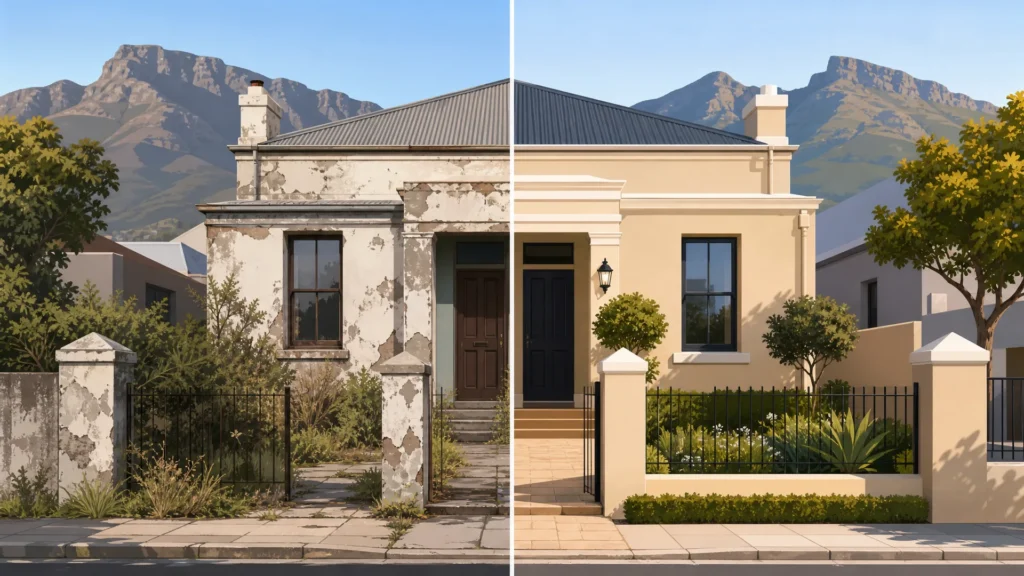
Few things reshape a property’s story as quickly as a well-planned exterior house renovation before and after transformation. In Cape Town’s competitive suburbs, from Claremont to Bloubergstrand, buyers, tenants, and valuers form an opinion before they reach the front door. That first impression is built entirely from the street, which means your facade, paint, landscaping, and roof all carry real financial weight.
Visual proof matters here. Descriptions of what was done rarely persuade; photographs of what changed almost always do. This article groups real-scope transformations into two categories, curb appeal refreshes and full home facade renovations, so you can match your budget and timeline to the outcome you want.
Why Exterior Renovation Before and After Results Matter
Property decisions in Cape Town increasingly hinge on street presence. Estate agents and property valuers broadly agree that a well-executed exterior renovation, fresh paint, repaired surfaces, and tidy landscaping, can meaningfully shorten the time a property spends on the market compared to an equivalent home with a neglected facade.
That’s why before-and-after evidence builds trust faster than any written assurance. When a prospective buyer or tenant sees the same property looking dated, then transformed, they understand the potential, and they understand your capability as an owner who invests in the asset.
Two scopes drive the majority of exterior transformations: a curb appeal renovation targeting paint, render, landscaping, and entry details; and a full home facade renovation covering cladding, roofing, waterproofing, and windows. Both are covered below with scope-level detail.
Scope 1, Curb Appeal Renovation: Maximum Impact, Minimal Disruption
A curb appeal renovation is the lighter scope, but light doesn’t mean underwhelming. Done well, it delivers some of the strongest visual return on investment of any home improvement type. The typical before: faded or discoloured plaster walls, cracked render at corners and window reveals, rusted or missing gutters, a tired front gate, and a driveway edged with overgrown planting. The after: crisp colour, clean lines, a repaired surface, and a front garden that frames the building rather than obscuring it.
A typical Cape Town semi-detached home in this condition can be transformed within two weeks through a full exterior repaint, render repairs, gutter replacement, and basic landscaping, emerging with a clean, contemporary street presence that changes first impressions entirely.
Fresh Exterior Paint and Render Touch-Ups
The single highest-impact change a homeowner can make to exterior presentation is a full repaint combined with render repairs. Experienced renovation contractors consistently hold this view: it costs a fraction of structural work, but the result reads as a near-total rebuild to anyone viewing the property from the street.
For a professional exterior house painting services project, preparation carries as much weight as the paint itself. Cracks and delaminated render are cut back, filled, and re-textured before a single coat is applied. Skipping that step guarantees the cracks reappear within a season. The colour selection, typically a light neutral body with a contrasting trim or feature wall, shifts the aesthetic from dated to contemporary without structural change.
Siding replacement is a worthwhile upgrade within this lighter scope for homes with timber or older fibre cement panels that have warped or split. Replacing those boards before painting avoids redoing paintwork when the siding eventually fails.
Landscaping Combined with Facade Updates
Landscaping amplifies every facade update. A freshly painted wall behind an overgrown, brown lawn still reads as neglected. The same wall behind a low-maintenance drought-tolerant planting scheme, fynbos species suit the Cape’s dry summers particularly well, reads as intentional and cared-for.
Within a curb appeal scope, landscaping typically means clearing overgrowth, regrading a sloped verge, laying decomposed granite or pavers on the driveway apron, and planting structured low-maintenance species along the boundary. A new or repainted front gate anchors the entry point. Together, these updates frame the facade renovation and extend the visual transformation from the kerb inward.
Scope 2, Full Home Facade Renovation: Structural and Aesthetic Overhaul
A full home facade renovation addresses the building envelope, not just its surface colour. The typical before on a Cape Town freestanding home: deteriorating plaster or original facebrick walls with efflorescence, water-stained soffits, an ageing IBR or flat roof with active leaks, louvre windows from a previous decade, and a garage door that no longer suits the house proportions. The after: a cohesive new material palette, a weatherproofed structure, contemporary windows, and a silhouette that looks like a different building.
A full facade renovation on a property of this type, including fibre cement cladding over existing brick, a torch-on waterproofing layer on the flat roof section, new aluminium windows, and a two-tone exterior paint finish, routinely runs three to five weeks and produces a near-unrecognisable before-and-after result.
At Wilcote, exterior renovation projects in the Cape Town market frequently combine siding or cladding work, exterior painting, and waterproofing into a single coordinated scope, reducing total project time and giving clients a cohesive finish rather than piecemeal updates.
Siding Replacement and Cladding Upgrades
Replacing or adding cladding is the defining move in a full facade renovation. Fibre cement panels over existing brickwork create a flush, modern surface and improve thermal performance. Stone veneer panels applied to the lower third of a facade add visual weight and change the building’s character entirely. Both materials handle Cape Town’s UV exposure better than timber, which requires regular maintenance cycles to avoid splitting and graying.
If you’re weighing up adding a home extension alongside your exterior renovation, coordinating the cladding specification at that point ensures the new and existing volumes match, a detail that’s easy to align during planning and expensive to correct afterward.
Roofing, Waterproofing, and Structural Exterior Work
Roofing decisions sit at the centre of a full facade renovation budget. Understanding whether to repair or replace your roof shapes the overall scope, a repair on a roof with fewer than five years of remaining life just defers cost rather than solving it. For flat roof sections, torch-on waterproofing versus other methods is a practical comparison worth making before the contractor quote stage, since the membrane type affects both cost and the maintenance interval.
New aluminium-framed windows and a contemporary garage door contribute more to the visual transformation than their individual cost might suggest. They anchor the renovation’s aesthetic, a new palette with old louvre windows reads as unfinished.
Material Choices That Define the Transformation
Plaster and paint is the most common exterior finish in Cape Town. It’s cost-effective, fast to apply, and achieves a smooth or textured finish depending on spec. Its weakness is maintenance: plaster cracks over time and needs inspection every few years. Applied correctly with a quality elastomeric paint, it performs well through the Western Cape’s wet winters and UV-heavy summers.
Facebrick requires no painting and weathers well in this climate, but it limits palette flexibility. Homeowners who want a contemporary look from a facebrick facade typically either render over it or use cladding as a contrast element, rather than painting the brick.
Fibre cement cladding has grown in popularity across Cape Town renovations because it resists UV degradation, doesn’t absorb moisture, and takes paint exceptionally well. It suits both a modern horizontal-board aesthetic and more traditional panel profiles.
Stone veneer adds texture and visual depth. It performs well in coastal zones, unlike real stone, the manufactured veneer panels are lightweight and bond reliably to existing substrates. Maintenance demand is low once properly sealed.
Material choice drives both the final aesthetic and the maintenance cycle. Selecting a material that suits the Cape’s climate means lower total cost of ownership over a decade than choosing purely on upfront price.
Curb Appeal ROI: What Exterior Updates Do for Property Value
Well-executed exterior updates consistently rank among the highest-return home improvements, and the reasoning is straightforward: a buyer’s first impression determines whether they enter the property willing to pay asking price or already negotiating downward in their heads.
In competitive Cape Town suburbs, a neglected exterior can significantly undercut an otherwise well-maintained interior. A buyer who sees peeling paint and cracked render before they reach the door has already discounted the property, and that discount rarely reflects the actual cost of fixing those surfaces, because buyers price in risk, inconvenience, and their own uncertainty about what else might be wrong.
Conversely, a home with a crisp, well-maintained exterior signals that the property has been looked after. Rental properties benefit equally: tenants judge a building’s management quality by its exterior. A well-maintained facade justifies a higher asking rent and attracts tenants who treat the property with the same care.
The curb appeal renovation is therefore not just an aesthetic exercise, it is a commercial decision with a measurable upside at sale or lease review.
Timeline Expectations and How to Plan Your Exterior Renovation
Planning an exterior renovation in Cape Town involves more variables than the building work itself. Use this checklist as a starting point:
- Define your scope first. Decide whether you’re doing a curb appeal refresh (one to two weeks) or a full facade renovation (three to six weeks). A scoping visit from licensed home renovation contractors in Cape Town will clarify this before any commitment.
- Get at least two detailed quotes. Quotes should itemise materials, labour, and preparation separately, a quote that lumps everything together makes comparison impossible.
- Account for material lead times. Imported fibre cement cladding and aluminium window systems are currently running longer lead times than domestic supply. Factor three to six weeks for materials before work can start.
- Check permit requirements. Most paint and render work does not require a permit. Structural changes, new roofing, and window replacements on certain property types may, confirm with your local municipality before starting.
- Time around Cape Town’s wet season. Avoid scheduling external painting or render application during June, July, and August. Rain interrupts cure times and can cause adhesion failure. Plan for preventing roof leaks ahead of Cape Town’s wet season as a separate but related priority before winter.
- Stage the work logically. Roofing and waterproofing first, then cladding or render, then painting, then landscaping last. Starting landscaping before painting is complete means redoing disturbed planting.
A single scoping visit is enough to clarify what transformation your property can realistically achieve, how long it will take, and what it will cost. Contact Wilcote for a free exterior renovation assessment and quote, no commitment required, and the result is a clear picture of both the visual outcome and the realistic budget before any work begins.