
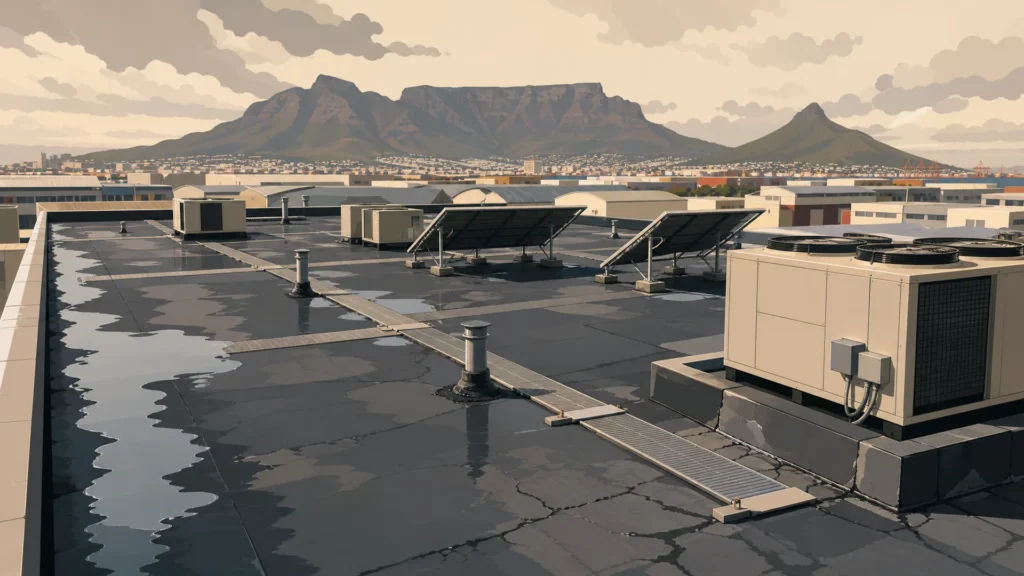
A leaking flat roof on a warehouse or retail block is never just a maintenance headache. It’s a business interruption risk, an insurance liability, and often a compliance issue that holds up a sign-off. Commercial roof waterproofing in Cape Town has to satisfy a different set of pressures than a house needs. Treating the two the same way is where most waterproofing failures start.
Why Commercial Roof Waterproofing Cape Town Demands a Different Standard
Residential waterproofing advice is easy to find, but it rarely accounts for what a commercial or industrial roof actually carries. A factory, distribution centre, or retail park roof isn’t just shedding rain. It’s supporting plant equipment, service access, and sometimes years of accumulated wear that a domestic roof never sees.
Wilco Te Cape Town has completed torch-on waterproofing and commercial roofing projects across the Cape Town metro, which gives the team direct experience with local wet-season failure points on flat industrial roofs. That project history shows a consistent pattern: commercial roofs fail earlier when they’re waterproofed with residential-grade thinking rather than a system built for sustained loads and heavier use.
How Commercial Loads and Traffic Differ from Residential Roofs
Commercial and industrial roofs routinely carry HVAC units, extraction ducting, solar mounts, and walkways for maintenance staff. Each of these is a penetration point or a wear zone that a membrane has to seal around and tolerate underfoot. Add regular technician foot traffic for servicing that equipment, and the membrane is under mechanical stress a typical house roof never experiences. A waterproofing system for these buildings needs enough puncture resistance and surface durability to handle that traffic without the seams degrading.
Compliance and Insurance Implications of Poor Waterproofing
Commercial properties also carry compliance obligations residential owners don’t face. Insurers increasingly expect documented proof of proper installation and maintenance before they’ll pay out on a water-damage claim, and a building certificate of compliance can be affected by an unresolved roof defect. If a roof fails and stock, machinery, or tenants are affected, the property owner needs paperwork showing the waterproofing was installed and maintained to a recognised standard, not just that “someone did the roof” at some point. For a broader view of what this involves across an entire property, see this overview of commercial building waterproofing in Cape Town.
Torch-On Vs Membrane Systems for Flat Roof Waterproofing Commercial Buildings
Flat roof waterproofing for commercial buildings generally comes down to a choice between torch-on bitumen membranes, liquid-applied coatings, and single-ply membrane systems. Each has a place. The right choice depends on the roof’s size, access, and how much movement or plant load it needs to tolerate.
When Torch-On Waterproofing Suits Commercial Buildings
Torch-on waterproofing remains a strong option for large, flat commercial and industrial roofs. The bitumen membrane is heat-welded into overlapping layers, which creates a continuous barrier that handles UV exposure and thermal movement well over time. It’s particularly suited to warehouses, factories, and retail units with big, uninterrupted roof areas, where a skilled installation crew can work efficiently across long runs.
A warehouse roof with ponding water and old, brittle membrane is a classic candidate for a full torch-on system replacement rather than a patch repair, since patched sections tend to fail again at the seams within a season or two. That’s an important distinction for commercial clients: torch-on systems are only as durable as the installation quality behind them, which is why the application method matters as much as the membrane brand.
Alternative Membrane Options for Industrial Roofing
Liquid-applied waterproofing systems suit roofs with complex detailing, awkward penetrations, or where downtime for torching isn’t practical. They form a seamless coating that’s useful around HVAC units and irregular roof shapes, though they generally demand more careful surface preparation and reapplication cycles than torch-on membranes.
Single-ply membranes are another option for large industrial roofs, offering lighter-weight installation and good flexibility. They can be a sound choice where roof structure or access limits torch-on application, though they typically come with different seam-jointing requirements that installers need to get right.
For a deeper technical breakdown of how these systems compare, this full comparison of torch-on waterproofing methods is a useful next step for facilities managers weighing options.
Durability, ROI and Warranty Terms for Industrial Waterproofing Solutions
Cost is rarely the only factor commercial clients should weigh. A cheaper waterproofing job with a weak warranty often costs more over the life of the roof than a properly specified system with real backing.
What a Commercial Roof Warranty Should Actually Cover
Waterproofing contractors generally agree that a workmanship warranty separate from the material manufacturer’s warranty is essential for commercial clients, since most leak failures stem from installation error rather than membrane defects. A warranty worth signing should spell out:
- The exact duration of both the material warranty and the workmanship guarantee
- What triggers a claim, and what’s excluded (ponding water, third-party damage, unauthorised roof access)
- Who is responsible for follow-up inspections during the warranty period
- Whether the warranty is transferable if the property changes hands
Vague, one-line warranty statements are a common red flag. If a contractor can’t explain in plain terms what’s covered and for how long, treat that as a warning sign before signing anything.
Estimating Long-Term ROI on Industrial Roof Waterproofing
Industrial waterproofing solutions are a capital cost, but they should be evaluated against what a failure would cost instead. Retail and logistics properties that skip scheduled roof maintenance often face far larger repair bills after a single bad storm season than the cost of two or three preventative inspections would have been. Stock damage, business interruption, and emergency callout rates all add up quickly once a leak is active rather than prevented.
When weighing a full system replacement against ongoing patch repairs, it helps to work from a clear framework rather than guessing. This decision framework for repairing vs replacing a roof sets out the key trade-offs, and a roof replacement cost estimate guide gives a concrete reference point for budgeting a project properly rather than reacting to a crisis quote.
Preventative Maintenance Plans to Stop Commercial Roof Leaks
Reactive repairs are almost always the most expensive way to manage a commercial roof. A structured maintenance plan catches small issues, a lifted seam, a blocked outlet, a cracked flashing, before any of them becomes an active leak affecting operations below.
Seasonal Inspection Checklist for Cape Town’s Climate
Cape Town’s rainy season, concentrated between May and September, places sustained hydrostatic pressure on flat commercial roofs. That’s why most reputable contractors recommend pre-winter inspections rather than waiting for a visible leak. A sensible seasonal checklist includes:
- Clearing drains, gutters, and outlets of leaves and debris before the wet season starts
- Checking membrane seams and flashing details around HVAC units and parapets
- Looking for ponding water that hasn’t cleared within 48 hours of rain
- Inspecting for UV-related brittleness or cracking on older torch-on membranes
- Confirming rooftop access points and walkways haven’t damaged the membrane surface
Building this into an annual calendar, rather than an ad hoc callout after a storm, is the difference between a maintenance cost and an emergency repair bill. For broader upkeep planning across a site, industrial building maintenance in Cape Town covers how roof care fits into overall facility maintenance, and this guide to seasonal maintenance to prevent roof leaks expands on the inspection routine itself. For torch-on specific guidance heading into winter, torch-on protection for Cape Town’s wet seasons is worth reviewing too.
Signs a Commercial Roof Needs Urgent Leak Prevention
Some warning signs shouldn’t wait for the next scheduled inspection:
- Damp patches or staining on ceilings below the roof, especially near penetrations
- Visible ponding that persists for more than a day or two after rain
- Blistering, cracking, or lifting at membrane seams
- A noticeable increase in humidity or musty smell in stored goods areas
- Any recent roof access work (solar installation, aerial mounting) without a follow-up inspection
Any of these justify calling in a contractor immediately rather than waiting for the next scheduled visit.
Choosing Commercial Roofing Contractors in Cape Town
Not every contractor who handles residential waterproofing is set up for commercial or industrial-scale work. The scale, compliance requirements, and warranty expectations are different, and it’s worth vetting accordingly.
Questions to Ask Before Signing a Waterproofing Contract
Before signing a contract, a property manager or business owner should ask:
- What warranty is offered, and does it separate material cover from workmanship cover?
- Can the contractor provide references or examples from other commercial or industrial projects?
- What insurance and public liability cover does the contractor carry for work on a business premises?
- Is the proposed system appropriate for this roof’s specific load, traffic, and access conditions, or is it a generic quote?
- What does the maintenance plan look like after installation, and is it priced separately or bundled?
A contractor who answers these clearly, with documentation to back it up, is a far safer commercial partner than one offering the lowest price with the least detail.
Getting commercial roof waterproofing right in Cape Town means matching the system to the building’s real demands, securing a warranty that actually protects the business, and building a maintenance routine around the region’s wet-season risk. Property managers and business owners who want a clear, compliant waterproofing plan can request a free roof assessment and quote to see exactly what their building needs before the next rainy season sets in.