
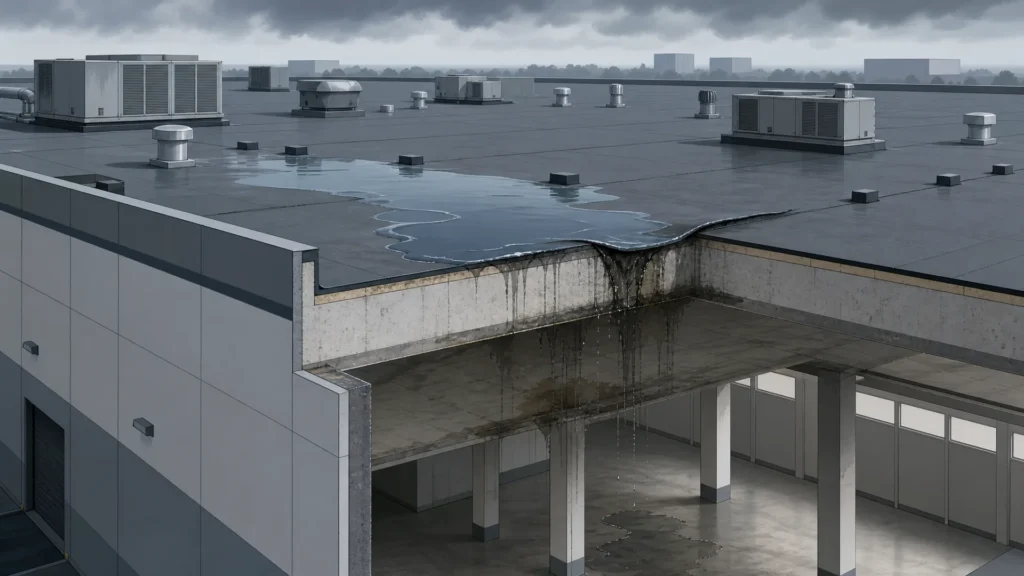
Commercial building waterproofing in Cape Town is a specialist discipline with risks, costs, and technical demands far beyond what a typical residential project involves. When a flat roof fails on a warehouse, office block, or retail centre, the consequences move fast, damaged stock, compromised electrical infrastructure, tenant liability, and potential forced closure. Getting waterproofing right on a commercial property is not just a maintenance decision; it is a business continuity decision.
Why Commercial Building Waterproofing in Cape Town Is a Different Challenge
Residential waterproofing usually covers a single sloped roof, a balcony, or a wet room. Commercial and industrial buildings introduce a different order of complexity entirely, one that demands specialist planning, specification, and execution.
The Scale Factor: Large Surface Areas and Complex Roof Geometry
A large commercial roof can cover thousands of square metres of flat or low-pitch deck. That scale amplifies every risk. A small membrane lift that would cause a minor ceiling stain in a house can funnel litres of water per hour into a commercial interior. Flat roofs accumulate water rather than shed it quickly, so any breach is immediately exploited by hydrostatic pressure.
Complex geometry adds further challenge. Large commercial roofs typically include penetrations for HVAC units, drainage outlets, skylights, and service hatches, each one a potential failure point if not detailed correctly. Managing these junctions across a large surface requires a systematic approach that small-scale contractors rarely have the experience or equipment to deliver.
Cape Town’s Climate and What It Means for Commercial Properties
Cape Town’s winters bring sustained rainfall and powerful south-westerly gales. The Cape Doctor, the strong south-easter that follows in the warmer months, cycles flat roof membranes through significant thermal expansion and contraction. Together, these forces work aggressively against any waterproofing system that is incorrectly specified or poorly installed.
A large Cape Town warehouse with an unprotected flat bitumen roof exposed to the Cape’s winter south-westers will typically show delamination, pooling, and internal moisture ingress within a few seasons, a pattern experienced commercial roofing contractors in the city encounter routinely. For commercial property managers, the message is clear: Cape Town’s climate does not tolerate deferred waterproofing maintenance.
Rising and penetrating damp in Cape Town buildings is often the first visible symptom of a roof membrane that has already been compromised for months. By the time water appears on interior walls, the deck and insulation beneath are frequently saturated.
Flat Roof Waterproofing Solutions for Commercial and Industrial Buildings
Flat roof waterproofing contractors in Cape Town specify several distinct systems, and the right choice depends on roof deck construction, existing drainage, foot traffic loading, and project budget. Understanding the core options helps property managers ask better questions at quotation stage.
Torch-On Membrane Systems for Commercial Roofs
Torch-on modified bitumen membrane is widely specified on Cape Town’s commercial and industrial flat roofs because it forms a seamless, heat-fused bond with the substrate, eliminating the lapped joints that are the most common point of failure on large roof decks. The bitumen sheet is rolled out and flame-applied, melting into the surface below to create a monolithic waterproof layer that resists both standing water and wind-driven uplift.
For large-scale and industrial building waterproofing, torch-on is the industry workhorse. It handles significant thermal movement, is durable under maintenance foot traffic, and, when applied in a two-layer system, delivers a service life measured in decades rather than years. Wilcote Cape Town has carried out waterproofing on large-scale commercial and industrial roofs across the Cape Peninsula, applying torch-on membrane systems where seamless, durable coverage is required to meet client uptime demands.
For a detailed comparison, see how torch-on compares to other waterproofing methods and the torch-on waterproofing guide for Cape Town’s wet seasons.
Liquid-Applied and Alternative Waterproofing Systems
Liquid-applied polyurethane and acrylic coatings suit situations where open-flame work is prohibited, such as roofs over occupied, sensitive, or high-risk occupancies. These systems are roller- or spray-applied and cure to form a flexible, seamless membrane. They work particularly well for maintenance overcoating of existing substrates and for irregular geometries where sheet membranes are difficult to detail neatly.
Liquid systems generally have a shorter primary service life than torch-on and require more frequent maintenance recoating, but their low disruption during application makes them attractive for occupied commercial premises. A commercial roof waterproofing provider should be able to advise which system, or which combination, is appropriate after inspecting the specific deck condition and building use.
Compliance, Building Codes, and Commercial Waterproofing Standards
South African commercial construction must comply with SANS 10400, the National Building Regulations. SANS 10400 Part L (roofs) and Part W (fire) set prescriptive requirements for roof coverings on commercial structures in South Africa, including waterproofing membrane specifications that insurers and municipal inspectors reference during compliance sign-off.
For commercial property managers in Cape Town, this has practical implications. A waterproofing installation that does not meet SANS 10400 requirements can void building insurance, trigger failed municipal inspections, and create liability exposure if water ingress causes property damage or personal injury. Using certified building waterproofing contractors in Cape Town who understand these standards, and who can provide documentation of compliant materials and installation methods, is not optional on a commercial project; it is a basic due-diligence requirement.
Commercial damp proofing work on properties with basements, below-grade storage, or sub-floor spaces must also satisfy structural waterproofing requirements that go beyond roof-level compliance. Any contractor quoting for complex below-grade work should be familiar with both SANS 10400 and the relevant SANS standards for structural waterproofing membranes.
Preventing Downtime and Protecting Business Operations
Water ingress into a commercial building is not a maintenance inconvenience, it is a business event. A warehouse with a leaking roof risks stock damage, compromises racking and electrical systems, and can trigger health-and-safety shutdowns. An office with active ceiling leaks cannot safely accommodate staff or tenants. A retail space that closes due to water damage loses revenue that no insurance settlement fully replaces.
Planned Maintenance Programmes vs. Emergency Repairs
The contrast between proactive and reactive commercial waterproofing is stark. Commercial property managers who schedule biannual roof inspections and address minor membrane lifts before Cape Town’s winter rains consistently avoid the far higher costs of full deck replacement, a principle that underpins every preventative maintenance programme in the industry.
Emergency waterproofing repairs arrive at the worst possible time: mid-winter, during active rainfall, with the roof already saturated. The cost per square metre rises sharply because contractors must work urgently, often using temporary measures while the deck dries. Business interruption adds further cost that rarely appears on the repair invoice but falls directly on the occupier.
Seasonal roof leak prevention in Cape Town covers the inspection schedule and early-warning signs that a planned maintenance programme should address before June each year. For larger portfolios, industrial building maintenance in Cape Town provides a broader framework for integrating roof waterproofing into a whole-building maintenance plan.
ROI and Long-Term Cost Savings on Waterproofing Commercial Properties
Waterproofing a commercial property is a capital investment, not an operating expense to be deferred. The return comes from three directions: protecting the asset’s structural integrity, reducing insurance risk, and extending the serviceable life of the roof system.
Early intervention on a failing membrane, addressing delamination, blister formation, or joint failure before water has penetrated the deck, costs a fraction of what full structural remediation costs once the deck substrate and insulation layer are saturated. Once water reaches the concrete or steel deck, the scope of work expands dramatically: the membrane must come off entirely, the deck must dry out, and any compromised insulation must be replaced before a new membrane can be specified. That sequence can cost many times more than addressing the original membrane fault.
From an asset management perspective, a well-maintained waterproofed roof supports higher property valuations, stronger lease terms, and cleaner due-diligence outcomes when a commercial property is sold or refinanced. For investors and property managers evaluating roof replacement cost estimates in Cape Town, the case for preventative waterproofing investment is straightforward: spend less, sooner, to avoid spending far more later.
When the membrane is already deteriorating and the question becomes repair versus replacement, the calculus shifts. Deciding whether to repair or replace a commercial roof depends on the extent of substrate damage, the remaining design life of the existing system, and the building’s planned use over the next decade, all factors a qualified contractor should assess before any quotation.
Choosing the Right Commercial Waterproofing Contractors in Cape Town
Waterproofing commercial properties in Cape Town requires contractors with demonstrably different capabilities from those who work primarily on residential homes. The vetting criteria that matter most for a commercial or industrial project are specific.
Registration and certification. NHBRC registration provides a baseline of contractor accountability. For commercial projects, also ask for evidence of relevant industry body membership and whether the proposed materials carry manufacturer approval for the application method being quoted.
Proven large-scale project portfolio. Ask for references and, where possible, inspect previous commercial and industrial work. A contractor with experience on roofs over 1,000 square metres understands the logistical, staging, and detailing challenges that smaller operators simply have not encountered.
Written guarantees. A reputable commercial waterproofing contractor provides a written workmanship guarantee tied to the project scope. This guarantee should be backed by a company with the financial standing to honour it, not a one-man operation that may not be trading when a defect appears in year three.
Site-specific assessment before quotation. No responsible contractor can accurately price a large-scale waterproofing job without inspecting the deck, reviewing drainage, assessing existing substrate condition, and identifying all penetrations and junctions. Any quotation issued without a site visit should be treated with scepticism.
Wilcote Cape Town offers free on-site assessments and written quotations for commercial and industrial waterproofing projects across the Cape Peninsula. If you manage a commercial or industrial building and want a professional assessment of your roof’s current condition, before the 2027 winter season arrives, contact Wilcote Cape Town to arrange a site visit. A written quotation, scoped to your specific building, costs nothing and provides the information you need to make a sound investment decision.