
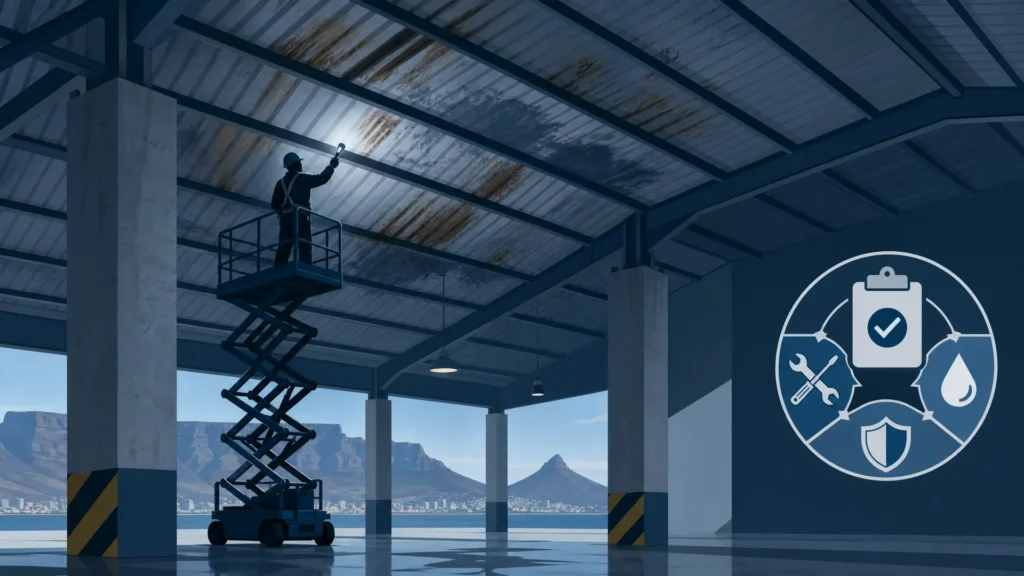
For factory and warehouse operators across the Western Cape, industrial building maintenance Cape Town is not a line item to defer, it is a core operational discipline. A well-structured preventative program protects production schedules, keeps structures compliant with South African safety law, and avoids the far steeper costs that follow neglect. This guide walks through what a full program covers, why Cape Town’s environment demands it, and how a maintenance contract delivers better outcomes than ad-hoc repairs.
Why Industrial Building Maintenance in Cape Town Can’t Be Reactive
The cost of unplanned downtime
Unplanned downtime in manufacturing environments consistently costs more per hour than any equivalent planned maintenance window. When a roof failure forces a production halt, the direct repair cost is only part of the damage: delayed shipments, spoiled stock, and idle labour compound quickly. Catching a problem during a scheduled inspection costs a fraction of what an emergency callout demands.
Cape Town’s climate as a silent aggressor
Cape Town receives around 500 mm of rain annually, concentrated in the winter months from May through August. Sustained south-easter winds drive moisture into roof laps, expansion joints, and cladding fixings in ways that inland sites rarely experience. Coastal salt air accelerates metal sheeting degradation and concrete carbonation. These combined forces mean bi-annual roof inspections, one before winter, one after, are industry best practice for any Western Cape factory or warehouse.
Core Components of a Preventative Maintenance Program
A structured preventative program is not a single trade visit. It is a documented, recurring cycle that covers every element of the building fabric.
Scheduled safety inspections
A safety inspection for an industrial site covers roofing integrity, waterproofing membranes, structural cladding and fixings, internal and external drainage, expansion joints, concrete surfaces, and electrical conduit covers. Each element is assessed, recorded, and rated so the maintenance contractor and facility manager can prioritise remedial work before small defects become costly failures. Documented inspection records also support insurance claims and compliance audits, making them a business asset, not just a maintenance tool.
Warehouse maintenance services: what a full scope covers
Full-scope warehouse maintenance services bring together several trades under one coordinated program. Roofing contractors inspect and repair sheeting, ridge caps, and penetrations. Waterproofing specialists assess and restore membrane systems on flat sections. Painters apply protective coatings to structural steel, cladding, and concrete to slow corrosion. Civil teams address spalling concrete, cracked aprons, and drainage blockages. Commercial painting contractors in Cape Town with industrial experience understand that protective coatings on factory structures serve a functional corrosion-control purpose, not an aesthetic one. A contractor who coordinates all these trades eliminates the gaps that appear when multiple specialists work without oversight.
Industrial Roofing: Cape Town’s Highest-Risk Maintenance Item
Roof failures are the leading cause of interior equipment damage in warehouse environments. Water that enters through a failed lap, a corroded fixing, or a cracked expansion joint can damage racking systems, electrical fittings, insulation panels, and stored goods, losses that far exceed the cost of the roof repair itself.
Common industrial roof failure points
Flat industrial roofs carry particular risk from ponding water. When drainage outlets block or membrane surfaces crack, standing water creates sustained hydrostatic pressure that forces moisture through even hairline defects. Corrugated and profile sheeting roofs fail most often at laps, ridge caps, and around penetrations such as vents and pipe boots. Expansion joints are another chronic failure point: they accommodate thermal movement but degrade over time as sealants harden and lose adhesion. Seasonal roof leak prevention in Cape Town addresses these failure points systematically rather than waiting for the first wet-weather leak report.
A Cape Town cold-storage warehouse that defers roof waterproofing inspections through winter often faces interior moisture damage to racking, insulation, and electrical fittings, repair costs that dwarf the annual cost of a preventative roofing contract. This plays out across the Western Cape industrial sector with enough regularity that experienced contractors treat pre-winter roof checks as non-negotiable.
Torch-on and membrane waterproofing for flat industrial roofs
Flat industrial roofs in Cape Town’s wet winters need a waterproofing solution that handles both hydrostatic pressure and thermal cycling. Torch-on bitumen membrane systems bond directly to the substrate, eliminate lap vulnerabilities, and provide a seamless barrier that can be inspected and patch-repaired without full replacement. For a comparison between systems, see torch-on waterproofing versus other methods and torch-on waterproofing protection for wet seasons. Whether a fully bonded torch-on or a cold-applied liquid membrane is the right fit for a specific roof profile is part of what a qualified contractor assesses during a scheduled inspection.
Safety Compliance and Regulatory Adherence for Industrial Sites
South Africa’s Occupational Health and Safety Act (Act 85 of 1993) places a legal duty of care on employers to maintain premises in a condition that is safe and without risk to health. For factory and warehouse managers, this obligation extends to the building fabric itself, not just machinery and processes. A structurally compromised roof, failing cladding, or blocked emergency drainage can constitute a contravention of that duty.
Documented building inspections convert a legal obligation into a defensible record. If an insurance claim arises following storm damage or a structural incident, a contractor’s inspection history demonstrates that the site was actively managed. A site with no inspection records faces harder claims assessments and potential disputes over whether damage was sudden or the result of long-term neglect. Scheduled safety inspections are the evidence trail that protects operators legally and financially.
The OHS Act makes factory managers personally accountable for premises safety. That accountability is best managed proactively, through a documented maintenance program, rather than reactively after an incident has occurred.
Factory Building Repairs: When Maintenance Finds a Problem
Preventative inspections do not eliminate repairs, they change when those repairs happen and what they cost. When a scheduled inspection identifies damp ingress, spalling concrete, failed coating systems, or deteriorating roof sheeting, the work can be planned, priced, and scheduled without urgency. The contractor can order materials, allocate the right crew, and minimise production disruption.
An emergency callout for the same problem, discovered during a downpour when water is entering the production floor, commands premium pricing, faster lead times, and often temporary measures that need to be redone properly later. Common factory building repairs identified during scheduled inspections include concrete spalling on columns and apron edges, exterior coating failure exposing structural steel, damp wall ingress at cladding junctions, and roof sheeting corrosion requiring panel replacement.
For damp wall solutions for Cape Town buildings, the treatment approach depends on whether the source is rising damp, wind-driven rain penetration, or condensation, distinctions a trained inspector can determine during a scheduled visit rather than guessing under pressure. Similarly, knowing when to repair versus replace an industrial roof requires a condition assessment, not an emergency snap judgement.
Industrial Maintenance Contracts: Getting Predictable Cost and Priority Response
A maintenance contract converts an unpredictable, reactive spend into a fixed, planned cost. For financial controllers and operations managers, that predictability matters: the maintenance budget can be set accurately at the start of each year, without contingency reserves for emergency callouts.
Beyond cost, a contract delivers site familiarity. A contractor who visits twice a year builds a condition history for every roof section, every drainage outlet, and every structural element. That history means defects are spotted earlier and understood in context, a crack that was 3 mm wide in June 2026 and 5 mm wide pre-winter 2027 tells a very different story than one seen for the first time during an emergency visit.
Maintenance contracts also provide priority scheduling. Ad-hoc clients compete for contractor availability alongside contract clients; in a post-storm period when demand surges, contract clients move to the front of the queue. For industrial sites where production continuity is critical, that priority alone justifies the contract arrangement.
Documented inspection records generated under a contract serve compliance and insurance purposes throughout the year. They demonstrate due diligence under the OHS Act, support insurance renewals with evidence of active maintenance, and provide the paper trail needed if a third-party claim arises following an incident on site.
Wilcote Cape Town’s teams work across industrial, commercial, and residential sites, giving factory clients a single contractor who understands both the structural fabric (roofing, waterproofing, concrete repairs) and the finish trades (protective coatings, painting) required for full-building compliance. A single point of accountability simplifies contract management and eliminates the coordination risk of managing multiple specialist subcontractors.
If you manage a factory, warehouse, or industrial property in Cape Town, contact Wilcote Cape Town to arrange a site assessment. The assessment identifies your building’s current condition, the maintenance scope required for OHS compliance, and the basis for a tailored maintenance contract quote, giving you the budget clarity and priority access your operation needs before the next winter season.