
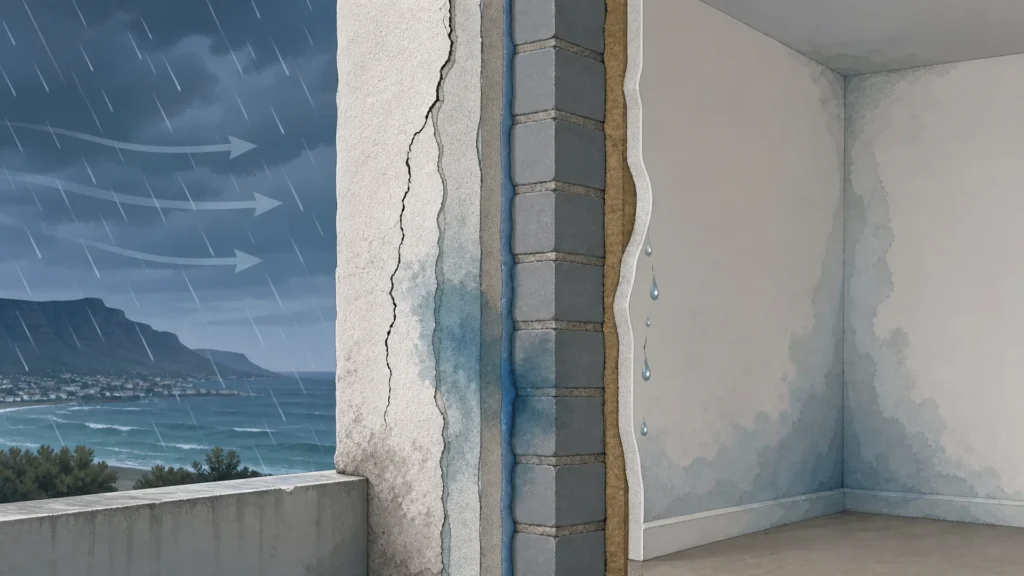
Damp walls are one of the most persistent and costly problems facing Cape Town property owners. The city’s Mediterranean climate creates ideal conditions for moisture intrusion, and a reliable damp walls Cape Town solution requires more than a coat of waterproof paint. It starts with an accurate diagnosis, followed by the right combination of waterproofing, rising damp treatment, and ventilation fixes. This guide walks through each step so you can make informed decisions about your property.
Why Cape Town’s Climate Makes Damp Walls a Serious Problem
Cape Town sits at the southern tip of Africa with coastline on three sides. That geography means sustained winter rain, high ambient humidity, and aggressive seasonal winds, a combination that tests every building’s envelope.
How Winter Rainfall and South-Easter Winds Drive Moisture Into Walls
Cape Town receives the bulk of its annual rainfall between May and August. In higher-lying suburbs, average monthly rainfall during this period regularly exceeds 100 mm, sustained wet spells that saturate external masonry and force moisture through any weak point in a wall or roof. When rain falls horizontally during a South-Easter gust, even well-maintained buildings face wind-driven penetration through cracked render, failed pointing, or poorly sealed window reveals.
The South-Easter also raises relative humidity dramatically along the Atlantic Seaboard and False Bay coastline. High indoor-outdoor humidity gradients slow the drying of wet walls and encourage condensation on cold surfaces, prolonging every moisture problem.
The Three Types of Dampness Found in Cape Town Homes and Buildings
Understanding which type of dampness you’re dealing with determines the correct treatment.
Rising damp occurs when ground moisture wicks upward through masonry via capillary action. It typically appears as a tide-mark stain at skirting level, rarely rising above 1–1.5 m. Salt deposits and peeling paint at low wall heights are classic signs.
Penetrating damp enters horizontally or from above, through cracked render, failed roof flashings, leaking gutters, or unsealed parapet walls. It follows the path of a defect and tends to appear as localised wet patches that worsen during or after rain.
Condensation dampness is caused by warm, moisture-laden air meeting cold wall or window surfaces. It produces surface mould, steamy mirrors, and a persistent musty odour. It’s also the most overlooked of the three in Cape Town’s climate.
How to Diagnose Damp Walls Before Choosing a Solution
Misdiagnosing the source of dampness is expensive. Treating rising damp symptoms with a condensation solution, or vice versa, wastes money and leaves the root cause intact. Getting the diagnosis right first is the most important step.
Visual Warning Signs: Staining, Efflorescence and Peeling Paint
Several visual clues indicate the type and severity of moisture intrusion:
- Tide marks at skirting level almost always signal rising damp.
- Efflorescence, white crystalline salt deposits on the wall face, means moisture is moving through the masonry and depositing dissolved salts as it evaporates. It appears in both rising and penetrating damp scenarios.
- Bubbling or flaking paint on internal walls suggests moisture pressure building behind the surface coating.
- Black or green surface mould, especially on north-facing walls or in poorly ventilated corners, points strongly to condensation.
- Musty odour without visible mould is an early condensation or concealed penetrating damp indicator.
In Cape Town’s Atlantic Seaboard and Southern Suburbs, unrenovated Victorian and Edwardian-era homes frequently lack a modern damp-proof course. When original lime mortar deteriorates, ground moisture has a clear path up the masonry, producing the classic tide-mark staining at skirting level that many owners mistakenly paint over.
Simple Tests Any Property Owner Can Do
Two field tests help narrow down the cause before a professional arrives.
The plastic sheet test: Tape a 300 mm × 300 mm sheet of clear plastic firmly over the damp patch and seal all four edges. Leave it for 24–48 hours. If moisture forms on the room-facing side of the plastic, the source is condensation. If moisture forms between the plastic and the wall, it’s rising or penetrating damp coming through the masonry.
The touch test: Press your hand against the damp area. A cold, wet surface that remains damp regardless of weather conditions suggests rising damp. A surface that is dry in dry weather but wet after rain points to penetrating damp.
Both tests have limits. A professional moisture meter and thermal imaging camera give far more precise readings, and in buildings with multiple damp types occurring simultaneously, professional assessment pays for itself by preventing misdirected treatment spend.
Rising Damp Solutions: From DPC Injection to Chemical Barriers
Rising damp is a structural problem. No amount of surface paint or primer permanently resolves it, because the moisture source, ground water moving through capillary pores, continues pushing upward regardless of what covers the wall face.
When a Damp-Proof Course Fails or Was Never Installed
A damp-proof course (DPC) is a horizontal impermeable layer built into the masonry at low level to block capillary moisture. In older Cape Town homes, particularly pre-1950s stock, the DPC is often absent, made from degradable materials like slate, or has been bridged by raised external paving or render.
Wilcote Cape Town’s renovation teams routinely find that damp reported as “a painting problem” is in fact a waterproofing or DPC failure, meaning a fresh coat of paint without fixing the underlying cause typically peels within a single rainy season.
The primary remedy for a failed or absent DPC is chemical injection, which introduces a new damp barrier into the existing wall without demolition.
Chemical Injection and Tanking Slurry for Internal Walls
Chemical DPC injection uses silane or siloxane cream injected under low pressure into a continuous series of holes drilled along the mortar course at low level. The cream disperses through the masonry pores, cures, and forms a hydrophobic barrier that breaks the capillary path. Damp specialists consistently note that this treatment only works when the mortar course is sufficiently dry before injection, treating saturated walls dilutes the cream and reduces long-term bonding. Diagnosis and a drying-out period must precede treatment.
Tanking slurry, a cementitious coating applied directly to internal wall surfaces, is used where rising damp cannot be fully stopped by injection alone, or where basement and below-ground spaces require waterproofing. It resists positive water pressure and provides a secondary barrier. Existing render is often hacked off first, slurry applied in multiple coats, then re-rendered with a sand-cement mix before finishing.
Together, DPC injection and tanking are the two most reliable rising damp solutions for Cape Town’s older building stock.
Waterproofing and Wall Dampness Treatment for Penetrating Damp
Penetrating damp almost always has a specific entry point: a cracked roof tile, failed parapet flashing, open joints in brickwork, or deteriorated window seals. Fixing the cosmetic damage on the internal wall without sealing the entry point guarantees a repeat failure.
For flat roofs and parapet walls, common on Cape Town’s converted warehouses, apartment blocks, and contemporary homes, torch-on waterproofing membranes are the premium solution. A polyester-reinforced bitumen membrane is heat-fused to the substrate, creating a seamless, fully bonded layer that resists the hydrostatic pressure of standing water. Understanding how torch-on waterproofing compares to other methods helps clarify whether torch-on, liquid membrane, or acrylic coating best suits a given substrate and exposure level.
For Cape Town’s wet seasons specifically, torch-on waterproofing protection for Cape Town’s wet seasons covers the application standards, membrane specifications, and maintenance expectations relevant to local conditions.
Commercial and industrial buildings in Cape Town’s inner-city precincts, particularly those converted from warehouses or older office stock, often show concentrated efflorescence around window reveals and below parapet walls. In many cases the root cause is a failed or absent parapet flashing rather than the wall material itself. Replacing the flashing and applying a torch-on detail at the parapet junction resolves the damp at source.
For external walls with cracked or porous render, flexible acrylic elastomeric coatings provide a breathable but water-resistant barrier. Cementitious coatings are appropriate where water pressure is higher. In all cases, defective pointing and cracked render must be repaired before any coating is applied, coating over open cracks traps moisture and accelerates further deterioration.
Ventilation Fixes That Stop Condensation Moisture at the Source
Condensation is the most overlooked cause of damp in Cape Town properties, particularly in newer, well-sealed buildings where reduced air exchange traps humid air indoors. The fix is not waterproofing. It’s moisture control through improved ventilation.
Practical ventilation fixes include:
- Extractor fans in kitchens and bathrooms ducted directly outside, not into ceiling voids. A fan that recirculates air through a filter removes odours but not moisture, ducted extraction is essential for humidity reduction.
- Trickle vents installed in window frames allow controlled background air exchange without draughts. They are especially effective in bedrooms where overnight breathing raises indoor humidity significantly.
- Positive-input ventilation (PIV) units draw filtered air from the loft space or outside and gently pressurise the building interior, displacing moist stale air outward through natural gaps. PIV is increasingly specified in Cape Town apartments and well-insulated homes where condensation is chronic.
- Daily habits matter: cross-ventilating rooms by opening windows on opposite sides of the building for 15–20 minutes morning and evening, and avoiding drying laundry indoors during winter, reduces the moisture load that ventilation systems have to handle.
Where condensation is concentrated around single-glazed windows, replacing them with double glazing with trickle vents raises the internal glass surface temperature and eliminates the cold surface that triggers condensation droplets.
Prevention Measures to Keep Walls Dry Long-Term
The most cost-effective damp walls Cape Town solution is preventing moisture entry before it causes structural damage. A few consistent maintenance habits achieve this.
Roof maintenance before winter: Inspect and replace cracked or slipped tiles each autumn. Clear gutters and downpipes of leaf debris before May, blocked gutters overflow against fascia boards and walls, forcing moisture into the wall cavity. Preventing roof leaks with seasonal maintenance outlines a practical inspection schedule suited to Cape Town’s seasonal pattern.
External render inspection: Hairline cracks in render widen during the dry summer months and allow winter rain direct access to the masonry beneath. Repointing open brick joints and patching cracked render every two to three years is far cheaper than treating the penetrating damp that follows.
Breathable masonry paint: Standard waterproof masonry paints trap moisture inside the wall, causing the face to blow and spall. Specifying breathable masonry paint applied by Cape Town specialists allows residual wall moisture to escape while repelling rain, the correct specification for walls that have previously had damp issues.
Exterior renovation: Beyond paint, cladding upgrades and render systems can significantly extend a building’s weather resistance. Exterior renovation transformations that protect property value shows how structural and cosmetic exterior work combine to reduce long-term maintenance costs.
Prevention costs a fraction of remediation. A single waterproofing failure left untreated through one Cape Town winter season can result in timber rot, plaster replacement, and mould remediation costs that dwarf what proactive maintenance would have cost.
When to Call a Professional for a Damp Wall Assessment in Cape Town
DIY treatment is reasonable for minor condensation, better ventilation habits and an extractor fan installation are within most owners’ reach. But several situations call for professional assessment without delay:
- Recurring damp after DIY treatment means the root cause was not identified or addressed. Every cycle of failed treatment adds cost.
- Tide marks, efflorescence, or structural cracking indicate rising or penetrating damp requiring specialist wall dampness treatment, chemical injection, tanking, or waterproofing membrane work.
- Mould affecting occupant health, particularly in homes with children or elderly residents, requires urgent remediation. Surface cleaning without fixing the moisture source brings mould back within weeks.
- Commercial or industrial buildings with tenant obligations or compliance requirements need documented professional assessment and a warranted treatment plan.
Licensed home renovation contractors in Cape Town from Wilcote Cape Town carry out professional damp assessments alongside integrated waterproofing, rendering, and renovation work, so the diagnosis, treatment, and finish are managed as a single project rather than a series of separate trade call-outs. If damp walls are affecting your property, the most productive next step is a site assessment that identifies exactly what you’re dealing with before any treatment budget is committed.