
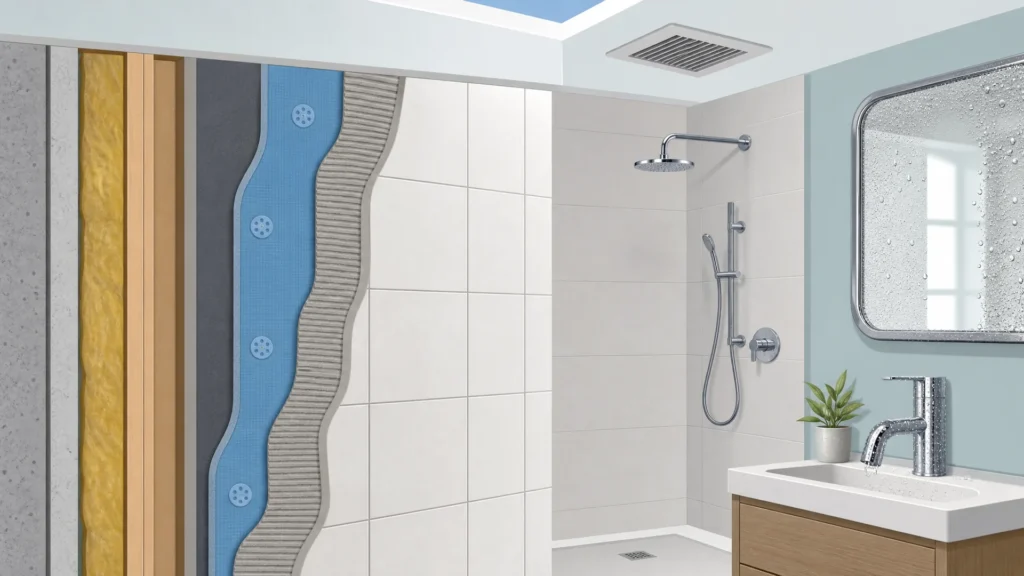
Cape Town’s winters are wet, its summers are humid, and its older housing stock was rarely built with bathroom moisture in mind. That combination makes bathroom renovation ideas here more consequential than a simple cosmetic refresh, get the materials and waterproofing wrong, and a beautiful new bathroom can start failing within a single rainy season. Get them right, and the result is a room that looks sharp, functions well, and holds its value for decades.
Why Cape Town’s Climate Demands Moisture-Smart Bathroom Renovation Ideas
Cape Town’s Mediterranean climate brings concentrated winter rainfall, followed by warm, humid summers, a cycle that pushes moisture into every vulnerable gap in a poorly designed bathroom. Without adequate ventilation and waterproofing, that moisture works its way into tile grout, behind wall surfaces, and eventually into subfloor timbers or concrete screeds.
The visible damage, bubbling paint, blackened grout, lifting tiles, is unpleasant. The invisible damage is worse. Subfloor rot, structural weakening, and persistent mould growth are common outcomes in Cape Town bathrooms where moisture management was treated as optional. These problems don’t stay contained either; rising and penetrating damp in Cape Town walls often originates in a bathroom that was never properly sealed.
Treating waterproofing as the foundation of any bathroom remodel, not an add-on, changes how every other decision gets made, from tile choice to vanity placement.
The Hidden Cost of Ignoring Humidity in Bathroom Remodels
Skipping or cutting corners on waterproofing creates costs that accumulate quietly. Grout failure typically appears first, within one to two wet seasons in a high-humidity environment. Once moisture penetrates behind tiles, remediation requires stripping the entire affected area, often far more wall or floor than the visible damage suggests.
Professional renovators consistently flag the shower-floor-to-wall junction as the single highest-risk area for water ingress. A gap of even a few millimetres in the membrane at this junction can saturate a subfloor within one wet season, turning a tiling job into a structural repair. That’s why a Cape Town waterproofing guide for wet seasons is worth consulting before any wet-room work begins.
Best Waterproof Materials for a Long-Lasting Bathroom Remodel
Choosing the right materials is where bathroom renovation ideas move from concept to durability. In Cape Town’s climate, every surface in a wet room should be selected with moisture resistance as a primary criterion, not an afterthought.
Tiles, Panels, and Surfaces That Resist Moisture
Porcelain tiles are the benchmark choice for wet-room floors and walls. Under ISO 13006 / EN 14411 ceramic tile classification standards, porcelain tiles with a water absorption rate below 0.5% are classified as impervious, the highest-performing category for humid environments. That near-zero absorption means water has nowhere to go, so the tile surface itself won’t harbour mould or degrade over time.
Ceramic tiles are a practical step down, still moisture-resistant but with slightly higher absorption rates, making them better suited to walls than shower floors.
PVC wall panels offer a grout-free alternative that works well in rental properties or budget renovations. They’re fully waterproof, straightforward to install, and available in finishes that mimic stone or timber. The trade-off is longevity, quality porcelain tile outlasts PVC panels under heavy use.
Moisture-resistant gypsum board (sometimes called green board or blue board) should be the minimum standard for any wall substrate in a bathroom, replacing standard drywall entirely. It won’t rot when exposed to incidental moisture, though it still requires a membrane waterproofing layer before tiling in a wet room.
Epoxy grout replaces cement-based grout in shower enclosures and wet floors. It’s non-porous, stain-resistant, and won’t crack or discolour, a direct answer to the grout failure that ends the life of so many Cape Town bathroom renovations prematurely.
Waterproofing Integration: What Goes Behind the Wall
Surface materials only perform as well as what’s behind them. Waterproofing integration means installing a continuous barrier before any tiles or panels go up, not filling gaps after the fact.
Liquid membrane waterproofing is brushed or rolled directly onto prepared substrates. It bonds to the surface, bridges hairline cracks, and creates a seamless layer flexible enough to accommodate minor building movement. It’s well-suited to walls and horizontal surfaces.
Torch-on membrane uses a bituminous sheet heated to bond to the substrate, creating a high-durability layer used primarily on shower bases, wet-room floors, and areas with high water volume. On Cape Town bathroom renovations where torch-on or liquid membrane waterproofing was integrated before tiling, projects consistently reported zero moisture callbacks, compared to repeat call-backs on patch-repair jobs where waterproofing was skipped entirely.
For a deeper comparison of these approaches, the detail behind torch-on versus other waterproofing methods is worth reviewing before committing to a specification.
Small Bathroom Upgrades That Maximise Space and Style
Many Cape Town homes, particularly older Victorian and semi-detached properties in the Southern Suburbs and City Bowl, have compact bathrooms. The best small bathroom upgrades work with the available footprint rather than fighting it.
Bathroom Layout Ideas for Compact Spaces
Floating vanities are one of the most effective upgrades in a small bathroom. Installed 150–200 mm off the floor, they allow the waterproofed floor membrane to run continuously underneath, preventing moisture from pooling behind cabinetry. In older Cape Town homes with limited under-floor ventilation, this detail pays real dividends. The exposed floor beneath the vanity also makes the room read as larger.
Wall-hung toilets free up floor space and make cleaning far easier, a practical benefit in a wet room that sees daily use. They also allow the cistern to be concealed in the wall, reducing visual clutter.
Pocket doors replace swing doors that eat into usable floor area. In a bathroom where every 100 mm counts, a pocket door can be the difference between a vanity that fits and one that doesn’t.
Large-format tiles (600 x 600 mm or larger) reduce the number of grout lines in a room, which simplifies the visual field and lowers the maintenance burden. Fewer grout lines means fewer points of moisture entry.
Storage solutions in small bathrooms should be built in, not bolted on. Recessed shower niches, waterproofed at installation with a brush-applied membrane, eliminate the need for a freestanding caddy. Mirrored cabinet units above the vanity add storage without consuming floor or counter space.
2026 Bathroom Remodel Trends Worth Considering
The bathroom remodel trends gaining traction in 2026 are notable because many of them converge on finishes and configurations that are also moisture-resistant, making style and practicality easier to align.
Neutral earthy tones, warm taupes, sandy greys, terracotta, continue to dominate bathroom palettes. These tones work naturally in porcelain and ceramic tile ranges, and the matte finishes common in this palette hide water marks better than high-gloss alternatives.
Matte black fixtures have moved from a premium option to a mainstream specification. Matte black tapware, shower fittings, and towel rails resist fingerprints and water spotting more visibly than chrome, and the finish holds up well in humid conditions when the coating quality is adequate.
Walk-in wet rooms are the most significant structural trend in 2026 bathroom remodel thinking. A continuous floor-to-ceiling porcelain tile finish with a fully bonded waterproof membrane beneath eliminates the traditional shower tray, removing the most common single point of failure in bathroom waterproofing. In Cape Town’s climate, a properly executed wet room is both the most stylish and the most durable configuration available.
Biophilic accents, small indoor plants, natural stone details, timber-look tiles, bring texture and warmth without requiring live materials in high-humidity zones. Timber-look porcelain delivers the aesthetic of wood with none of the moisture vulnerability.
Storage Solutions and Finishing Touches That Work Hard in Wet Rooms
Storage in a bathroom fails when the materials weren’t selected for humidity. Standard MDF cabinetry in a Cape Town bathroom is a long-term liability, it swells, delaminates, and eventually fails at joints and edges.
PVC cabinetry is the most moisture-proof option and suits rental and mid-range renovations. Marine-grade plywood, sealed and painted, offers superior structural performance and is the preferred choice for custom vanity units and built-in storage in higher-end projects. Both outperform standard particleboard or MDF in humid conditions by a wide margin.
Recessed shelving should be waterproofed at installation, not left as raw plasterboard behind tile. A brush-applied membrane on the shelf base and back wall before tiling takes minimal time and prevents the shelf cavity from becoming a moisture trap.
Rust-resistant hardware, stainless steel or brass with appropriate coatings, should be specified for all towel rails, toilet roll holders, and cabinet handles. Cheap chrome fittings rust visibly within two to three years in a well-used Cape Town bathroom.
Interior paint in bathrooms should be rated for high-humidity environments, typically a washable, mould-inhibiting formulation designed for wet areas. For guidance on how paint choices interact with small spaces, interior painting ideas for small spaces covers the practical considerations in detail.
Budgeting Your Bathroom Renovation: Tiers from Refresh to Full Remodel
Bathroom renovations in Cape Town generally fall into three practical tiers.
Cosmetic refresh involves repainting, replacing fixtures (taps, towel rails, toilet seat), re-grouting with epoxy, and adding new accessories. No structural work, no retiling. This tier suits bathrooms that are structurally sound but visually dated. Waterproofing at this level means sealing the existing grout lines and addressing any visible gaps at the shower tray junction, small interventions that prevent larger problems.
Mid-range upgrade includes retiling wet areas, replacing the vanity and toilet, upgrading tapware, and improving lighting. At this level, waterproofing is non-negotiable: stripping tiles to re-lay them without installing a proper membrane is a false economy that will require a full redo within a few years. Budget for liquid membrane waterproofing on all wet surfaces before tiling begins.
Full structural remodel reconfigures the bathroom layout, replaces all plumbing, installs new wet-room or shower enclosure structures, and may involve moving walls. This is where torch-on membrane on floors, moisture-resistant board on all walls, and fully specified drainage become the baseline, not upgrades. Projects at this level also benefit from cross-referencing with other renovation work happening in the home; kitchen renovation costs and budget tiers in Cape Town provides a useful parallel for homeowners managing multiple scopes simultaneously.
Regardless of tier, the one area where budget should never be compressed is the waterproofing layer and the quality of grout and adhesive. These are the lowest-cost components relative to their impact on the longevity of the entire renovation.
If you’re planning a bathroom renovation and want a professional assessment of your space’s moisture risks and layout potential, licensed home renovation contractors in Cape Town with experience in waterproofing integration are the right starting point, the investment in getting the brief right pays back throughout the project. For a sense of what well-executed projects deliver, before-and-after home renovation transformations illustrate the scope of what’s achievable when both design and waterproofing are handled correctly from the outset.