
Weatherproofing old houses is one of the most rewarding and most technically demanding renovation challenges a Cape Town homeowner can take on. These buildings were constructed for a different era, using materials and methods that simply don’t behave the way modern construction does. Get it wrong, and you trap moisture, accelerate decay, and spend far more fixing the damage than the original upgrade cost. Get it right, and a pre-1940s home can be drier, more energy-efficient, and more structurally sound than it has been in decades, without losing the character that makes it worth owning.
Why Weatherproofing Old Houses Is Different From Modern Builds
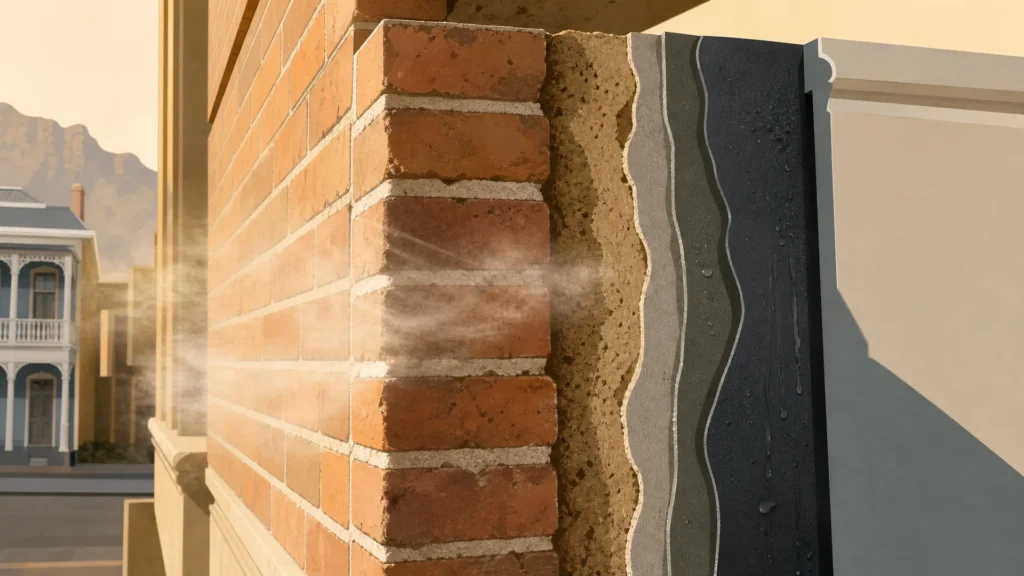
A new build is designed around modern barrier principles: cavity walls, synthetic waterproof membranes, and non-porous render systems keep water out by blocking it entirely. Old houses in Cape Town were built on a different logic, breathability and controlled moisture movement. Using modern barrier products on a structure designed to breathe can redirect water rather than eliminate it, causing spalling, efflorescence, and internal damp that is harder to diagnose and far more expensive to fix.
The Hidden Vulnerabilities of Aged Materials
Single-skin brick Victorian and Edwardian homes common across Cape Town’s older suburbs, Woodstock, Observatory, and Bo-Kaap among them, rely on lime-based mortars that allow walls to breathe. Applying a cement render or modern barrier sealant without accounting for this can redirect moisture laterally and cause internal spalling.
Beyond the mortar, original timber joinery expands and contracts significantly with Cape Town’s seasonal temperature swings. Steel-frame windows, once common in post-war homes, corrode at their frames and create gaps that grow wider every winter. Corrugated iron roofs develop micro-rust around nail penetrations. Each of these vulnerabilities demands its own diagnostic and product approach. There is no single-product fix for an aged building.
Respecting Heritage While Updating Performance
The goal is not to make the building perform like a new one. It is to stabilise it, reduce moisture ingress, and extend its service life using products and methods that work with the original structure rather than against it. That means choosing breathable sealants over rigid barriers, flexible membranes over brittle ones, and reversible interventions wherever the building’s heritage status makes future change likely.
A phased, materials-aware approach is not optional. It is the only approach that reliably works on aged stock.
Foundation Sealing and Damp Control in Historic Homes
Damp at the base of an old Cape Town wall is common, but the cause matters enormously. Treating rising damp with the same product you’d use for penetrating damp, or vice versa, will make the problem worse.
Rising Damp vs. Penetrating Damp: Diagnosing First
Rising damp is one of the most frequently diagnosed defects in pre-1960 South African residential properties. Original damp-proof courses were either absent, made from bitumen felt that has since degraded, or were bridged by later additions such as tiled floors laid over the existing DPC level. It presents as a tide-mark on interior walls, typically below one metre, with associated salting and paint failure.
Penetrating damp enters through cracks, failed pointing, or porous masonry above ground level. It follows rain events and often presents in patches rather than bands. Distinguishing between the two requires a moisture meter reading across wall height and, in some cases, a core sample to check for a surviving DPC.
Rising and penetrating damp solutions for Cape Town walls covers both conditions in detail, a useful next step once you’ve identified the source at your property.
Modern Foundation Sealing Methods That Don’t Trap Moisture
Breathability is the critical factor when choosing a foundation sealing system for an old house. Sealing an aged foundation with a rigid, impermeable product forces moisture upward into the wall structure, sometimes solving the external damp while creating far worse internal conditions.
Flexible cementitious coatings applied to the external face of a foundation wall allow water vapour to migrate out while blocking liquid water ingress. For flat or near-flat perimeter slabs, torch-on bitumen membrane applied to the external face of the foundation can provide a durable waterproof layer without trapping moisture inside the structure, provided the substrate is fully dry before application. Both methods suit the uneven, aged substrates typical of Cape Town’s older homes better than rigid epoxy or polyurethane injection systems.
Roof Weatherproofing for Older Structures
The roof is the first line of defence in any weatherproofing strategy, and deferred maintenance here turns into structural damage faster than anywhere else. Cape Town’s wet winters and dry summers create an aggressive cycle of thermal expansion and contraction that works at every joint, nail hole, and lap seam.
Assessing Roof Structure Before Any Weatherproofing Work
No membrane or coating should go onto a roof until the structure beneath it has been inspected. Applying a waterproof layer over rotted battens, corroded purlins, or deteriorated sarking locks in existing damage and guarantees early failure of the new system.
For original corrugated iron roofs, inspection focuses on rust penetration at the laps and around fasteners, batten condition underneath, and the integrity of ridging and flashings. Slate roofs require individual tile assessment, cracked or de-laminating slates must be replaced before any surface treatment. Clay tile roofs need checking for cracked tiles, failed mortar at hips and ridges, and sagging sections that indicate batten failure.
If structural issues are significant, the decision between repair and replacement needs to be made before any waterproofing spend is committed. Deciding whether to repair or replace an ageing roof can help you frame that decision clearly. For seasonal maintenance to prevent roof leaks in Cape Town, a regular inspection schedule between major works is the most cost-effective protection available.
Torch-On Waterproofing and When It Suits an Aged Roof Deck
Torch-on bitumen membrane systems, when applied to a structurally sound flat or low-pitch roof deck, create a seamless waterproof layer that outperforms traditional felt in Cape Town’s alternating wet-and-dry seasons, provided the substrate is properly prepared and free of trapped moisture before torching begins.
For older homes with flat concrete roof decks or enclosed lean-to additions, torch-on is often the most practical choice. It conforms well to aged, slightly irregular surfaces and its flexibility accommodates the thermal movement that cracks rigid systems. It is not suitable as a direct overlay on deteriorated timber decking or on pitched corrugated iron without first addressing the substrate. Understand how torch-on waterproofing compares to other methods before committing to a system, and consider torch-on waterproofing protection through Cape Town’s wet seasons for timing your project to maximise the curing window before the rains arrive.
Window and Wall Weatherproofing: Old House Updates That Last
Windows are one of the most common entry points for wind-driven rain in older Cape Town homes, and also one of the most visible elements of a building’s heritage character. Full replacement is rarely the first or best answer.
Sealing Timber Sash and Steel-Frame Windows Without Full Replacement
Draught-proofing timber sash windows with brush-pile or silicone compression seals, rather than replacing them outright, is a reversible, heritage-sympathetic intervention that reduces heat loss and wind-driven rain infiltration without altering the building’s historic character. The Society for the Protection of Ancient Buildings has long advocated this approach as the preferred first response for historic timber windows, and it applies directly to the Victorian and Edwardian joinery found across Cape Town’s older suburbs.
For steel-frame windows, the priority is treating any active corrosion at the frame before sealing. A rust converter followed by a flexible exterior-grade sealant at the frame-to-wall junction addresses the two main failure points without requiring replacement. Where frames have deformed beyond adjustment, partial replacement of a sash or panel is far less disruptive, and less expensive, than full window replacement.
On external walls more broadly, Wilcote Cape Town’s renovation teams routinely encounter old houses where previous owners applied exterior masonry paint directly over unprepared damp walls, a combination that accelerates paint failure and conceals ongoing moisture ingress rather than resolving it. Proper surface preparation, damp diagnosis, crack repair, and primer selection, determines whether a wall coating lasts two seasons or twenty. Why surface preparation is critical before exterior painting explains the prep sequence in full and is worth reviewing before any exterior coating work begins.
Planning a Phased Approach and Budgeting for Historic Home Updates
A coherent phased plan protects your budget and prevents new work from being undermined by unresolved problems elsewhere in the building.
The correct sequence for most historic home updates in Cape Town is: roof and gutters first, foundation and rising damp second, windows and external walls third, and cosmetic finishes last. Working in this order ensures that water is excluded from above before damp at the base is treated, and that wall and window finishes are applied to a stable, dry substrate. Reversing the sequence, painting walls before fixing the roof, for example, is the most common cause of premature paint failure on older Cape Town properties.
Budget realistically. Aged substrates frequently reveal additional defects once work begins: failed lintels, corroded tie rods, or concealed timber decay. A contingency of 15–20% over your initial estimate is prudent on any pre-1940s property.
Heritage constraints are also a practical planning consideration. Cape Town properties covered by heritage overlay zones, particularly those in declared Heritage Areas or on the SAHRA provincial register, may require approval from Heritage Western Cape before external alterations, including changes to roof material, window profiles, or visible wall finishes. This applies to many pre-1940s properties in areas like the Bo-Kaap, parts of Woodstock, and the Cape Malay Quarter. Check the overlay status of your property early, as approval timelines can affect your project schedule.
Exterior renovation transformations that boost property value shows what a well-sequenced, full-scope exterior renovation can achieve on Cape Town’s older building stock, useful context when presenting a phased plan to co-owners or investors.
Choosing the Right Renovation Partner for Old House Weatherproofing
The contractor you choose matters as much as the products they use. A team experienced only in new-build waterproofing can cause more damage than they prevent on an aged structure.
Look for a contractor who can demonstrate specific experience with aged and heritage substrates: lime mortar repointing, breathable coating systems, and the diagnostic process for distinguishing damp types. Ask directly whether they understand the difference between breathable and barrier products, and why that distinction matters for single-skin brick construction.
Coordination capability is equally important. Weatherproofing an old house typically spans roofing, waterproofing, and painting trades. A contractor who manages all three under a single scope reduces the risk of gaps between scopes and ensures that surface preparation standards are consistent from trade to trade.
For homeowners and property managers ready to move from assessment to action, working with licensed home renovation contractors in Cape Town who specialise in older building stock is the most direct way to get an accurate diagnosis, a realistic scope, and weatherproofing work that protects the building without compromising what makes it worth protecting.