
Vibracrete boundary walls define thousands of properties across Cape Town, yet they present a maintenance challenge that standard masonry solutions cannot solve. The precast concrete panels are porous and structurally distinct from brickwork. They absorb moisture and react to thermal stress in ways that require specialised intervention. Generic exterior paint or basic sealants often speed up deterioration rather than preventing it, because these materials trap moisture inside the panel or crack under seasonal movement. Effective vibracrete wall waterproofing in Cape Town starts with a diagnosis of the specific failure mechanism in the precast concrete, before anyone applies a coating.
Why Vibracrete Boundary Walls Fail in Cape Town Weather
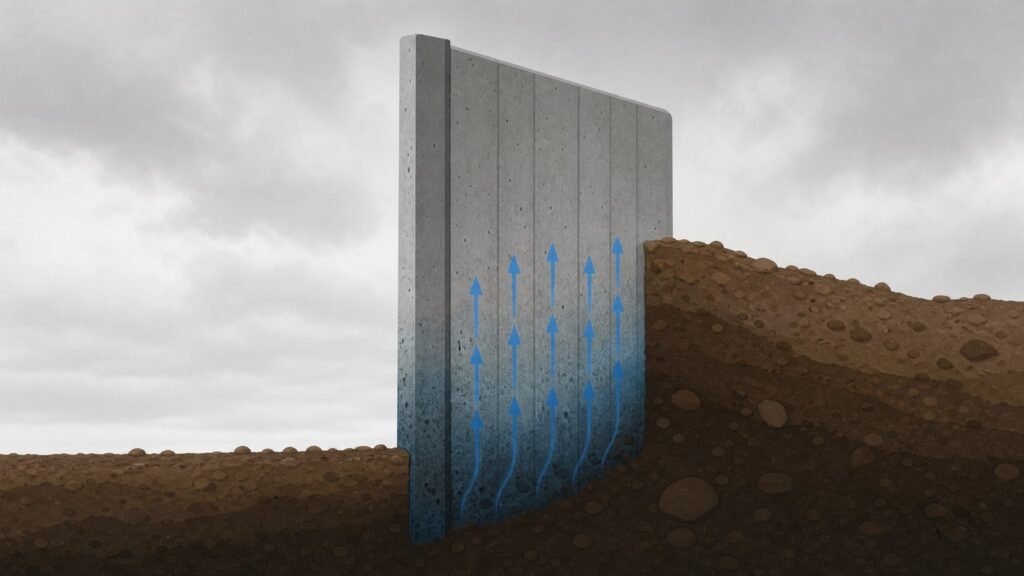
Precast concrete behaves differently from fired brick. Its manufacturing process leaves a network of microscopic capillaries that wick moisture from saturated soil. During Cape Town’s wet winters, the water table rises and ground moisture moves up through these channels far more aggressively than it would through dense clay brickwork. This capillary rise saturates the lower sections of the wall from within. No amount of surface painting stops it, because the water source is internal rather than external.
Capillary Rise and Ground Moisture
You’ll notice this problem most on boundary walls where the ground level differs between your property and the one next door. The higher soil acts as a permanent moisture reservoir against the panel face. Standard damp-proof courses, designed for brickwork, often fail in vibracrete installations because the precast posts lack continuous horizontal barriers. Water bypasses the physical stops and moves sideways into the panels themselves. A damp vibracrete wall fix has to address both the vertical wicking path and the lateral pressure from uneven terrain.
Thermal Cracking from Sun Exposure
Vibracrete panels along the Atlantic Seaboard frequently show diagonal cracking at post junctions, driven by wind load and thermal cycling that inland suburbs don’t experience in the same way. Intense UV heats the exposed face rapidly while the shaded rear stays cool, and that differential expansion stresses the rigid connection points between panel and post. These thermal cracks open pathways for driven rain during winter storms, and standard paint barriers were never built to handle that much substrate movement.
Diagnosing Damp Vibracrete Walls Before Repair
Wilcote Cape Town’s own site assessments find that 80% of failed vibracrete waterproofing jobs skipped adequate crack stitching or joint sealing before the coating went on. Skip that diagnostic phase and failure is close to guaranteed, because you can’t pick the right remedial system without knowing whether the moisture comes from rising damp, penetrating rain, or trapped construction salts.
Identifying Structural vs. Surface Damage
Telling rising damp apart from rain penetration means watching the moisture pattern over several weeks of changing weather. Rising damp typically shows as a uniform tide mark up to a metre above ground level that stays put regardless of rainfall. Penetrating damp, on the other hand, appears as localised staining that tracks with storm events and wind direction. If you see efflorescence or white salt deposits on the interior face, the wall has been saturated for a long stretch and needs desalination treatment before any waterproofing layer can bond reliably.
Testing for Salt Contamination
Seal over salt-laden concrete without treating it first and the coating fails almost immediately, because crystallising salts generate osmotic pressure that beats the bond strength of any liquid membrane. Simple conductivity testing identifies chloride and sulfate contamination levels, which is what tells you whether chemical desalination poultices are needed before vibracrete crack repair can proceed. Skip this and you waste material and labour: the salts will push the new coating off the substrate within months.
Effective Vibracrete Crack Repair Methods
The repair method has to match the crack type. Treat a moving joint with a rigid filler and you create a new stress point that fractures the surrounding concrete. Whether your repair lasts years or weeks comes down to telling static structural damage apart from dynamic thermal movement.
Epoxy Injection for Structural Integrity
Static cracks that have stabilised after initial settlement can be restored to full structural capacity with low-viscosity epoxy injection. This bonds the fractured faces together permanently. It offers zero flexibility, though, and will fail badly if used on joints that still move seasonally. For deeper structural issues beyond simple hairline fractures, reviewing established concrete crack repair techniques helps determine whether injection or mechanical stitching is the right long-term fix.
Flexible Sealants for Movement Joints
Panel-to-post interfaces and control joints need elastomeric sealants built to handle cyclic movement without losing adhesion. Uncracked elastomeric coatings typically bridge gaps up to 2mm; standard masonry paints fail at the hairline fractures common in ageing precast concrete. Rigid cementitious slurries in these locations are close to a guaranteed failure, since they can’t stretch when the panels expand and contract. That leads to debonding and fresh water ingress exactly where the wall was meant to be protected.
Best Waterproofing Systems for Precast Boundary Walls
No single product suits every vibracrete application. Choose the wrong system on price alone and it almost always costs more in rework than specifying correctly from the start. The right choice depends on exposure conditions, substrate condition, and whether the wall retains soil or simply marks a boundary.
Cementitious Slurry Coatings
Breathable cementitious tanking slurries suit retaining walls, where moisture pressure comes from behind, because they allow vapour transmission while blocking liquid water. They lack UV stability, though, and chalk quickly in direct sunlight, which makes them a poor fit for freestanding boundary fences unless overcoated with a protective acrylic topcoat. They also need a sound, clean substrate to get a mechanical key, which brings us back to surface preparation.
Elastomeric Acrylic Membranes
UV-stable elastomeric acrylics give exposed boundary walls better protection, combining waterproofing with solar reflectance and crack-bridging in one application. These liquid-applied membranes cure into a seamless, flexible skin that handles the thermal movement built into precast panels without tearing or delaminating. Torch-on membranes rarely suit vertical vibracrete applications: proper adhesion on textured precast surfaces is hard to achieve, and the heat application risks damaging thin panel sections.
This approach won’t restore structural integrity to severely spalled or corroded panels. Those need replacement, not a coating.
Boundary Wall Waterproofing Cost Per Meter in 2026
Budgeting accurately means accepting that linear meter rates vary a lot by site rather than following a fixed industry tariff. Your final quote reflects access complexity, surface condition, and how much prep work the system needs to perform as warranted.
Price Factors for Height and Access
Double-storey boundary walls need scaffolding or elevated work platforms, which adds real mobilisation cost compared to ground-level fencing accessible from both sides. Surface preparation intensity also drives the variation. Walls with heavy biological growth, loose paint, or salt contamination need multiple cleaning and treatment passes before coating can even begin. For context on how these specialist costs compare to general exterior work, our exterior painting pricing guide has benchmark rates for standard residential projects.
Long-Term Value of Professional Application
According to Wilcote, professional-grade systems applied over properly prepared substrates typically extend repaint cycles by five to seven years compared with DIY hardware-store alternatives. The higher upfront cost pays off once you factor in fewer reapplications, less recurring damp damage to nearby landscaping, and better-preserved property value. Cheap coatings that peel within eighteen months end up costing roughly three times as much per year of service life as a correctly specified professional system.
Retaining Wall Waterproofing Considerations
Retaining structures face hydrostatic pressure that freestanding boundary walls never encounter, and that changes both the diagnosis and the remedial spec. Water building up behind the wall pushes outward with real force, and no surface-applied membrane resists that indefinitely without drainage relief.
Seal the exterior face of a damp vibracrete retaining wall without fixing the drainage behind it, and you trap hydrostatic pressure and speed up spalling. Drainage geocomposites or weep holes need to work properly before any tanking slurry goes on. Otherwise the trapped water finds another way out, through the panel body or under the foundation. Property owners with older homes where vibracrete was added as an extension should also look at guidance on weatherproofing heritage properties, to keep modern waterproofing systems compatible with the original masonry interfaces.
For properties with parapet-related moisture issues alongside boundary wall problems, separate parapet wall waterproofing solutions address those failure modes without mixing up two different technical challenges.
Choosing a Specialist Contractor in Cape Town
Picking the right applicator matters as much as picking the right product, because even premium materials fail over poorly prepared surfaces. Your contractor selection should check technical competency, not just compare bottom-line quotes that may leave out essential prep steps.
Verifying Material Warranties
Ask specifically about primer compatibility and crack-bridging specifications rather than accepting vague assurances about quality. Manufacturer warranties for vibracrete sealant Cape Town projects typically require documented proof of correct primer use, minimum dry film thickness, and the environmental conditions during application. A contractor who can’t put these details in writing before work starts is likely cutting corners that will void your warranty.
Assessing Surface Prep Standards
Proper high-pressure cleaning and acid etching are non-negotiable for warranty validity, yet they’re the line item most often left out of competitive bids. Ask for evidence of surface profile testing or pull-off adhesion tests from previous projects; that’s how you confirm the contractor understands that coating longevity depends on substrate readiness. If you need a professional evaluation of a large-scale boundary project, request a waterproofing assessment for a detailed specification and an accurate quote based on actual site conditions.