
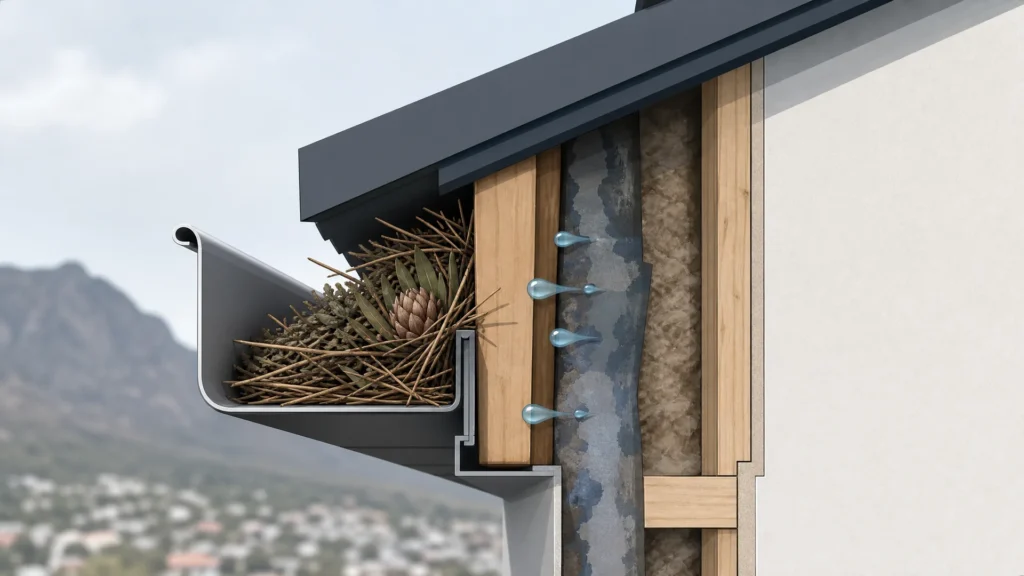
Cape Town’s weather tests every part of a building envelope, but gutters often fail first. They take the direct force of winter frontal rains and summer southeasters. When drainage fails, water doesn’t just disappear. It migrates into fascia boards, works into wall cavities, and undermines waterproofing membranes that were otherwise sound. Professional gutter repair in Cape Town targets this failure point before minor blockages turn into structural damp or timber rot. The focus is restoring correct flow and sealing integrity, not slapping on a patch that washes away with the next cold front.
Why Gutter Repair in Cape Town Prevents Costly Water Damage
Your property’s drainage system is the primary shield for the building envelope, yet it’s the most overlooked item on a routine maintenance inspection. Industry experience suggests that over 60% of external wall damp issues in Cape Town homes start with overflowing or leaking gutters, not rising damp or membrane failure. That makes accurate diagnosis essential before you commission expensive remedial work.
How Blocked Gutters Cause Fascia Rot and Damp Walls
Fynbos debris and pine needles build up fast in Cape Town valleys, forming dense mats that hold moisture against timber fascia boards long after the rain stops. That constant wetness speeds up fungal decay in the wood behind the gutter, and eventually the fixing points holding the whole system in place give way. Once the fascia softens, water tracks sideways into the wall cavity and shows up as interior damp patches that no amount of internal painting will fix. You can find effective solutions for damp walls once the external water source is dealt with, but treating the symptom without fixing the gutter guarantees it comes back.
The Link Between Faulty Gutters and Roof Leaks
Wilco regularly diagnoses “roof leaks” that turn out to be blocked gutters forcing water back under the tiles. Fixing the drainage first avoids unnecessary and costly roof stripping. When water can’t exit through the downpipe, it pools at the eaves, and capillary action draws it upward beneath the lowest course of tiles or sheeting. This reverse flow bypasses the primary waterproofing layer and soaks the ceiling insulation, producing damage that looks just like an active roof failure. Understanding typical roof leak repair costs shows why clearing a blockage now is cheaper than replacing saturated ceiling boards and damaged trusses later.
Gutters don’t cause roof leaks directly. They create the hydraulic pressure that exposes existing weaknesses in flashing and tile alignment.
Common Causes of Gutter Failure in Cape Town’s Climate
Local conditions degrade gutter materials faster here than in inland provinces. Specifications need to account for salt spray, UV intensity and the local vegetation. Cape Town’s mix of winter frontal rains and summer southeasters creates a thermal cycle that makes standard PVC gutters go brittle and crack faster than they would inland.
Storm Debris and Leaf Buildup
Northern suburbs with established pine forests, and coastal areas thick with fynbos, generate more debris than a standard residential gutter is built to handle. Fine needle-like material slips through ordinary leaf guards and packs down at the downpipe entries, forming blockages that resist a simple flush. Commercial properties with large roof catchments carry compounded risk: a single blocked outlet can divert thousands of litres across sensitive façade elements during peak rainfall. Cleaning schedules need to track the local vegetation cycle, not a generic annual date, or overflow damage follows.
Rust and Corrosion from Coastal Air
Salt-laden air in the Atlantic Seaboard and False Bay suburbs corrodes mild steel brackets and galvanised fittings within a few years of installation. Rust jacking expands the metal components inside timber fascias, splitting the wood and loosening the gutter’s grip even when the trough itself still looks fine. Aluminium and marine-grade stainless steel hardware resist this, which is why they’re the standard choice for lasting repairs in exposed coastal zones. Check bracket fixings once a year and you’ll catch corrosion before the gutter tears loose in a storm.
Poor Installation and Incorrect Slope
Many original installations used too few brackets or the wrong fall ratio. That was fine in a low-rainfall climate; it fails under Cape Town’s winter downpours. Gutters put up without proper expansion joints buckle and split at the seams when a 35°C summer day is followed by a rapid cool-down from the afternoon sea breeze. Downpipes sized for average rainfall can’t handle the peak flow from a cut-off low, so joints and outlets surcharge and flood. Fixing these design flaws takes a proper assessment, because resealing a visible leak treats the symptom, not the hydraulic miscalculation underneath it.
Bracket spacing shouldn’t exceed 750mm on exposed coastal elevations, regardless of what the manufacturer’s general guidelines say.
Signs You Need Professional Gutter Repair or Replacement
Catching problems early is what separates affordable maintenance from an emergency rebuild, yet many property owners miss the subtle signs until interior damage forces their hand. A visual inspection during dry weather turns up problems that stay invisible during rain, when attention is naturally fixed on wherever it’s actively leaking.
Visible Sagging, Cracks, and Rust Stains
Sagging sections point to bracket failure or timber rot behind the mounting surface, and both need more than a simple realignment. Vertical rust streaks below joints signal chronic seepage that has already eaten through the protective coating and started on the substrate. Hairline cracks in PVC or fibre cement troughs widen with every thermal cycle, going from a slow drip to a split during a temperature extreme. Photograph these defects and a contractor can quote accurately without multiple site visits.
Overflow During Rain and Interior Damp Patches
Water spilling over the gutter edge in moderate rain confirms either inadequate capacity or a blockage that cleaning alone won’t clear. Damp marks on the interior wall directly below the overflow point confirm the link between the drainage failure and the damage inside. Ceiling stains near external walls often trace back to water getting in at eaves level rather than a failed roof membrane, especially when the stain follows the line of the gutter. Spotting that distinction can save you from paying for a roof replacement you don’t need, when targeted blocked gutter repair would solve it.
This kind of visual diagnosis doesn’t hold for properties with concealed box gutters or heritage-listed buildings that need specialist conservation sign-off.
Gutter Repair vs Full Replacement: Making the Right Choice
The decision comes down to the age of the material, the extent of corrosion, and how many repairs it’s already had, not the up-front cost alone. The logic in deciding whether to repair or replace a roof applies just as well to drainage systems, where patching aged components eventually stops paying off.
When Patching and Resealing Is Sufficient
Isolated joint failures in an otherwise sound system respond well to professional resealing with UV-stable polyurethane sealants built for South African conditions. Localised bracket replacement restores correct alignment as long as the surrounding timber is still structurally sound and rot-free. Spot repairs make economic sense on systems under ten years old with a documented maintenance history and no widespread corrosion. But if you’re resealing the same joints again and again, that points to systemic movement or thermal stress that a patch can’t fix for good.
Benefits of Seamless Gutters for Long-Term Durability
Seamless aluminium gutters are increasingly the choice for Cape Town replacements because they remove the mid-span joints where roughly 90% of leaks develop in a traditional sectional system. Continuous extrusion allows on-site fabrication to the exact building dimensions, cutting out the measurement errors that plague pre-cut sectional installs. With no intermediate seals, the main failure point disappears, and fall stays consistent across long runs that would otherwise need several joints. Thermal expansion happens evenly along the whole length instead of concentrating stress at a handful of connection points.
Seamless systems typically carry longer material warranties than sectional alternatives, according to manufacturer literature, worth confirming directly with your installer.
Gutter Replacement Cost and Repair Pricing in Cape Town
Pricing swings a lot depending on access difficulty, the material spec, and how the scope is bundled, not just a flat rate per metre. Getting a proper quote means an on-site assessment, because satellite imagery can’t show fascia condition, bracket corrosion, or the routing complexities of a downpipe, and those are what actually drive the labour hours.
Typical Price Ranges for Repairs and Downpipe Fixes
Minor leak sealing and bracket replacement sit at the lower end of the cost scale when scaffolding or a cherry picker isn’t needed. Downpipe repair in Cape Town costs more when pipes run internally through soffits or tie into underground stormwater systems that need excavation. Full section replacement with new brackets and sealant sits in the mid-range, as long as the existing timber fixings are sound. Emergency call-outs during an active storm come at a premium that a planned maintenance contract avoids entirely.
Factors Influencing Seamless Gutter Installation Quotes
Building height and roof pitch decide what equipment the job needs, and that has a real effect on labour costs for seamless installations. Heritage properties needing colour-matched finishes may require custom powder coating, which stretches the lead time and the material cost. Bundling gutter replacement with scheduled exterior painting cuts mobilisation costs, since the same access equipment does both jobs. Get three comparable quotes and you’ll see whether the pricing reflects your actual site or just a generic rate card that skips the hidden complications.
Ask for an itemised breakdown that separates materials, labour and equipment hire, so you can compare contractors properly.
Commercial Gutter Maintenance for Industrial and Office Buildings
Commercial properties carry different liability exposure and operational constraints than a home does. Facility managers have to weigh drainage reliability against tenant disruption, safety compliance and asset protection, which calls for a proactive approach rather than a reactive one. A commercial roof maintenance guide sets out baseline standards for inspection frequency and documentation on non-residential assets.
Safety regulations require certified anchor points and fall arrest systems for gutter work above the regulated height threshold on commercial premises. A scheduled maintenance contract spreads the cost across fiscal periods and keeps you inside the insurance warranty conditions that lapse when drainage is neglected. Large industrial roofs generate runoff volumes that overwhelm a domestic-scale downpipe, so they need engineered stormwater solutions from a hydraulic specialist. Inventory stored directly under a vulnerable eaves line is a concentrated risk, and that’s reason enough to invest in redundant drainage paths and overflow alarms.
Keep a documented maintenance log. It’s your best defence if an insurance claim dispute follows a water damage incident in a leased commercial space.
Bundling Gutter Work with Roofing and Waterproofing Services
Combining the work into one project saves more than shared labour costs; it also fixes the interface details that separate trades tend to ignore. Wilco can handle the entire building envelope, so the flashings, gutters and membranes work together instead of leaving gaps between one contractor’s scope and the next.
Saving Money by Combining Projects
Shared access equipment removes the duplicate mobilisation charge when gutter replacement lines up with roof waterproofing or exterior painting. Coordinating the trades avoids the scenario where painters finish a surface that the gutter installers then damage fixing brackets. Material suppliers offer volume discounts when an order combines roofing membranes, sealants and aluminium extrusions under one purchase order. On multi-storey buildings, these savings add up fast, since crane or cherry picker hire is a large fixed cost no matter how the scope is split.
Extending Gutter Lifespan Through Integrated Care
New waterproofing membranes tie directly into the gutter lining, creating one continuous water-shedding surface without the vulnerable lap joints you’d otherwise get at the eaves. Fresh paint applied right after the gutter goes in protects the newly exposed timber fascia during the critical curing period. Flashing replacements timed with the gutter work keep the overlap sequence correct, which stops water being drawn back into the wall cavity by capillary action. Piecemeal repairs can’t match this because each component here is reinforcing the one next to it, not working alone.
Get a waterproofing quote that includes a gutter assessment, so integration opportunities get flagged before you commit to separate tenders.