
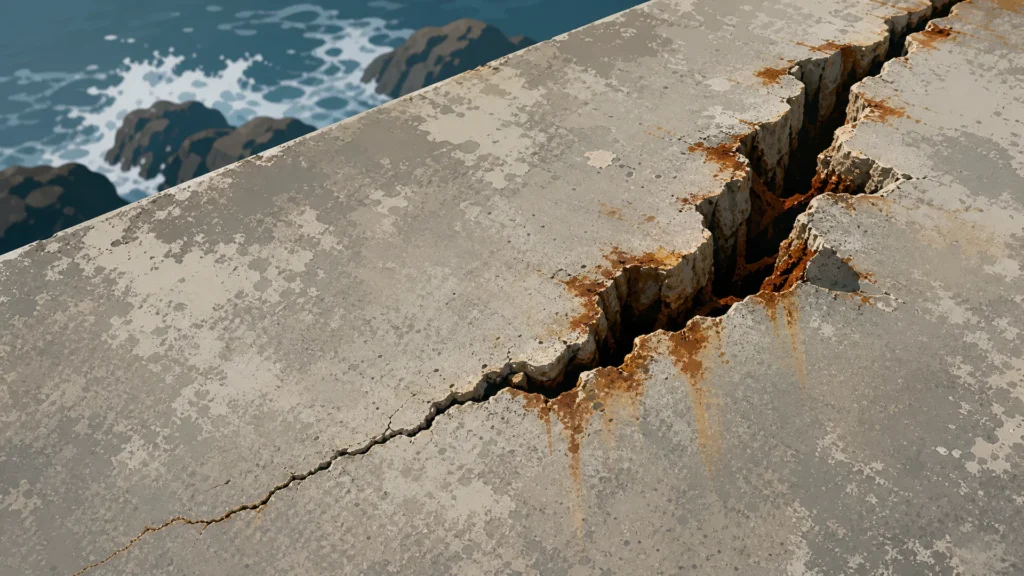
Concrete doesn’t crack the same way in Cape Town as it does inland. Salt air, wind-driven rain, and sharp seasonal swings all put extra stress on slabs, driveways, and foundations. If you own or manage a commercial property here, understanding concrete crack repair in Cape Town means understanding the climate first and the repair method second. This guide walks through why cracks form, how to classify them, what each fix costs, and when a DIY sealant job is enough versus when you need a professional structural assessment.
Why Concrete Cracks in Cape Town’s Climate
Concrete is porous. It expands, contracts, and absorbs moisture depending on temperature and humidity. In Cape Town, those conditions change fast and often. That’s part of why concrete crack repair here looks different from repair work in more stable inland regions.
Salt Spray and Coastal Corrosion
Properties near the coast face a specific threat: salt-laden air. Salt speeds up corrosion of the steel reinforcement bars inside concrete slabs and foundations. Once rebar starts rusting, it expands. That expansion pushes outward on the surrounding concrete, and hairline cracks widen from the inside out.
Wilcotecapetown’s repair crews routinely assess coastal properties from Sea Point to Muizenberg. Salt-laden air accelerates rebar corrosion in these areas and widens hairline cracks within a few seasons. That’s why coastal commercial buildings, especially those with basement parking or seafront-facing walls, tend to need crack inspections more often than properties further inland.
Freeze-Thaw and Seasonal Moisture Swings
Cape Town doesn’t get the deep freezes that cause classic freeze-thaw damage further north. But it does get a sharp contrast between hot, dry summers and wet, wind-driven winters, and that swing still matters for concrete.
The swing between hot, dry summers and wet, wind-driven winters puts concrete through repeated expansion-contraction cycles. Those cycles widen existing cracks faster than in more stable inland climates. Water that gets into a crack during winter rain can also reach the reinforcement steel, adding to the corrosion problem described above. That’s why moisture management matters as much as the crack repair itself. Sorting out rising and penetrating damp solutions alongside crack repair often prevents the same damage from recurring the following winter.
Concrete Crack Repair Methods by Crack Type and Severity
Not every crack needs the same fix. Choosing the right one of several concrete crack repair methods starts with an honest look at how wide the crack is, whether it’s growing, and whether it affects structural elements or just surface finish.
Hairline and Surface Cracks
Cracks under about 1mm wide, with no visible movement, usually fall into the “monitor and seal” category. These are typically shrinkage cracks from the original concrete cure, or minor surface cracking from weathering. A flexible concrete crack sealant suited to Cape Town conditions is usually the right entry-level fix here. It keeps water out without needing structural intervention
.
Concrete Structural Crack Repair
Cracks wider than 3mm, cracks that run diagonally from corners, or cracks paired with visible displacement between the two sides are a different category entirely. Property managers are increasingly advised to treat any crack wider than 3mm, or one that’s actively growing, as a structural concern. That means a professional inspection, not a DIY sealant job. Concrete structural crack repair usually starts with an engineer’s assessment, followed by injection and, in some cases, added reinforcement or underpinning.
Epoxy Concrete Crack Repair Explained
Epoxy concrete crack repair uses a two-part resin injected directly into the crack under pressure. It bonds the two faces of the concrete back together, restoring some of the structural continuity that was lost. Standard sealants work differently: they fill the gap and keep out water and debris, but they don’t re-bond the concrete.
Epoxy is the right call for structural or load-bearing cracks. Polyurethane injection is often used instead where the crack is still moving slightly, or where active water infiltration needs to be stopped first, since polyurethane expands and seals even in damp conditions. Sealant, by contrast, is a surface-level fix suited to hairline, non-structural cracking.
How to Repair Concrete Cracks in Cape Town: Step-by-Step
For minor, non-structural cracks, a competent property owner can handle the repair directly. Here’s how to repair concrete cracks in Cape Town properties without over- or under-treating the problem.
Preparing and Cleaning the Crack
- Widen the crack slightly with a grinder or chisel to create a clean channel for the sealant to grip.
- Remove all loose debris, dust, and old sealant with a wire brush and vacuum.
- Check for moisture inside the crack. If it’s damp, let it dry fully, or use a moisture-tolerant product designed for that situation.
- Mask the area around the crack to keep the repair neat.
Applying Sealant or Epoxy Correctly
- Check the weather forecast. Cape Town’s wind-driven winter rain can wash out an uncured sealant, so avoid application if rain is expected within the product’s cure window, typically 24 to 48 hours.
- Apply a bonding primer if the product calls for one.
- Inject the sealant or epoxy from the bottom of the crack upward, to avoid trapping air pockets.
- Tool the surface flush, and let it cure fully before exposing it to foot traffic, vehicle loads, or water.
- Inspect again after the next heavy rain to confirm the seal held.
This process works well for hairline and surface cracks. Anything wider, structurally suspicious, or recurring after a first repair should move to a professional assessment instead.
Concrete Foundation Crack Repair vs Driveway and Slab Repair
Foundations, driveways, and slabs all crack for different reasons, and they carry different levels of risk. Treating them the same way is one of the most common mistakes property owners make.
Foundation Crack Warning Signs
Concrete foundation crack repair carries higher stakes than surface work. Foundation cracks can signal settlement, water pressure against the wall, or corroding reinforcement. Warning signs include cracks that run diagonally, cracks wider at the top or bottom than in the middle, doors and windows that stick, and visible gaps that grow across a few months of observation. Any of these justify a professional structural inspection before anyone applies a sealant.
Concrete Driveway Crack Repair Cost Factors
Driveways and slabs face a different set of stresses: repeated vehicle loads, pooling rainwater, and exposure to sun and salt air if the property is near the coast. Concrete driveway crack repair cost depends on a few clear factors: how wide and how long the crack is, whether the slab needs re-levelling, whether reinforcement mesh needs replacing, and how much surface area needs resealing.
Driveways and parking areas exposed to reversing vehicle loads and pooling rainwater tend to redevelop cracks faster after a DIY patch than after a professionally keyed and reinforced repair. That’s a key trade-off for commercial parking areas with heavy daily traffic. A professional repair, even at higher upfront cost, often works out cheaper over several years than repeated patching.
Cost Comparison: DIY vs Professional Concrete Crack Repair
Cost scales directly with severity. A typical Cape Town commercial warehouse slab with hairline cracks under 1mm can often be sealed for a fraction of the cost of a structural crack that requires epoxy injection and engineering sign-off. Broadly, repairs fall into three tiers: sealant-only work for hairline cracks, epoxy or polyurethane injection for moderate cracks with some depth, and full structural repair with reinforcement for foundation or load-bearing damage. Each tier up adds materials, labour time, and often an engineer’s assessment fee.
When DIY Sealant Makes Sense
DIY sealant is a reasonable choice when the crack is under 1mm, isn’t growing, isn’t near a structural element, and shows no signs of active water ingress or reinforcement corrosion. It’s a sound, low-cost way to stop small cosmetic issues before they let moisture in.
When to Call a Commercial Concrete Crack Repair Specialist
Bring in a commercial concrete crack repair specialist when the crack is wide, growing, structural, or when the property carries liability exposure that a DIY fix can’t cover. Commercial property owners also need to think about warranty. A professional repair typically comes with a workmanship guarantee, and that matters for insurance, tenant liability, and resale value in a way a weekend DIY patch simply doesn’t. When in doubt on a commercial building, the cost of a professional assessment is small next to the cost of a failed repair discovered during a lease inspection or sale.
Preventing Future Cracks and Long-Term Concrete Maintenance
Repairing a crack without addressing what caused it usually means repairing the same crack again in a year or two. Long-term prevention comes down to controlling water and monitoring the structure.
Good site drainage keeps rainwater from pooling against foundations or driveways. That reduces both hydrostatic pressure and the risk of water reaching reinforcement steel. Waterproofing exposed concrete surfaces, particularly roofs and parapets during Cape Town’s wetter months, cuts down significantly on new crack formation. Options like torch-on waterproofing for wet seasons are worth considering for flat roofs and exposed slabs that see heavy winter rain.
Property owners dealing with cracked walls alongside cracked concrete should also look at surface finishes. A cracked render repair guide helps distinguish cosmetic render cracking from the structural concrete issues covered here, since the two are often confused but need very different fixes.
For commercial and industrial sites, a scheduled inspection routine catches new cracking before it becomes a structural or safety issue. Rolling crack repair into a broader industrial building maintenance program also spreads cost more evenly across the year instead of facing one large repair bill. Pairing that with commercial building waterproofing services addresses the moisture side of the problem directly, rather than treating cracks as an isolated issue.
Finally, treating crack prevention as part of cost-saving renovation practices makes financial sense for owners planning to hold or sell the property. Preventing a structural crack is consistently cheaper than repairing one after it’s spread.
If you’re seeing new or widening cracks on a commercial or residential property in Cape Town, it’s worth getting a professional opinion before deciding between a sealant, an epoxy injection, or a full structural repair. Wilcotecapetown offers free on-site assessments, giving you an honest severity rating and a clear quote before any work begins.